
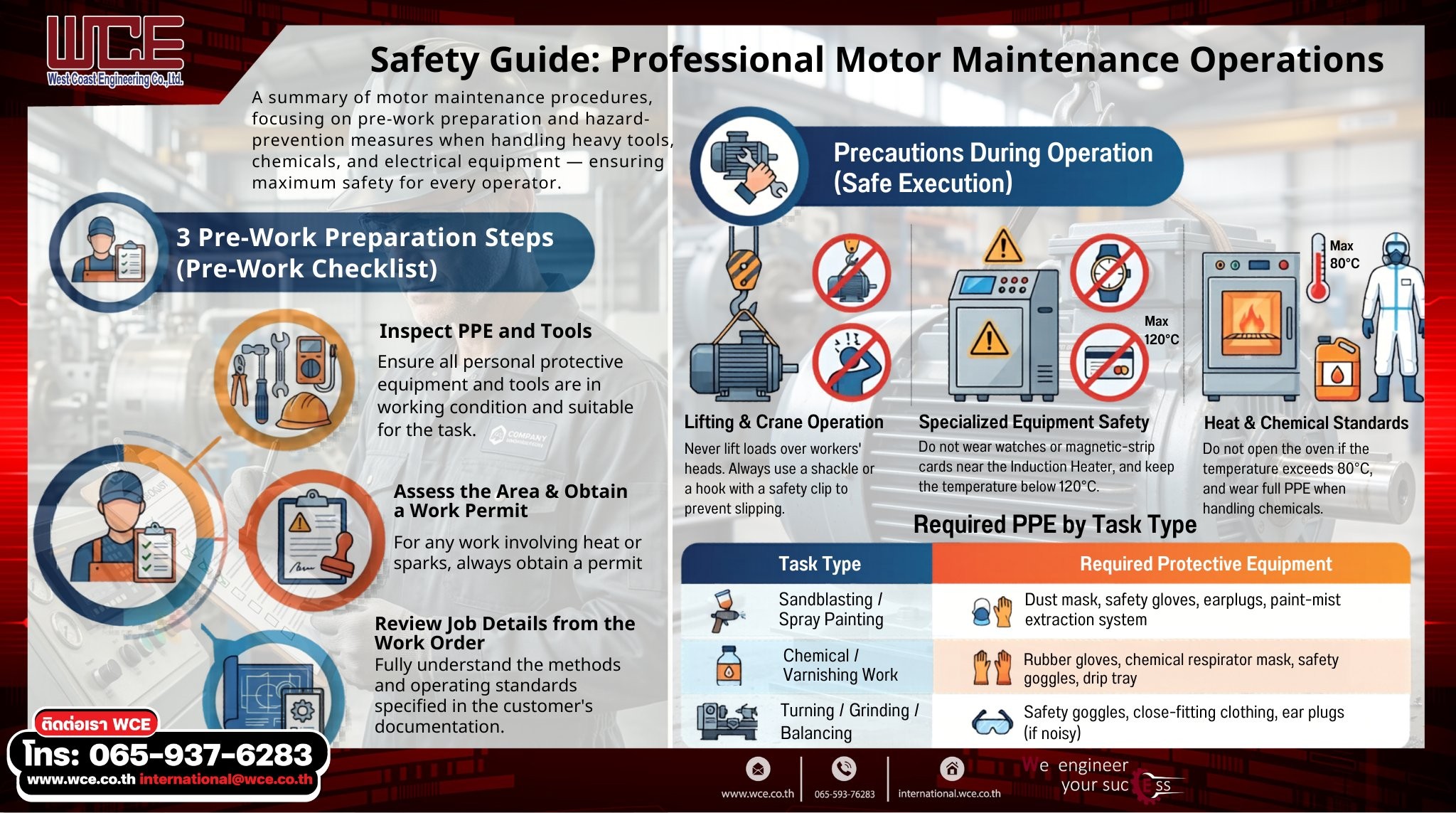
Electric motors are the heart of every industrial production line, which makes motor maintenance a job that demands technical expertise and safety discipline in equal measure. Technicians work with heavy tools, chemicals, heat, and electrical equipment — often all within the same task. This article summarises the safety practices that run through the entire motor maintenance process, from pre-work preparation to final electrical testing, drawing on real operating procedures together with international safety standards and Thai regulations.
1. Before You Start: Prepare Thoroughly
Most maintenance accidents trace back to incomplete preparation. The steps you take before picking up a tool matter just as much as the work itself.
Review the work order — fully understand the methods and operating standards specified in the customer’s documentation before you begin.
Inspect PPE and tools — Every item must be in working condition and suitable for the task. Never use the wrong tool for the job, and report any abnormality to your supervisor immediately.
Assess the work area — The area must be free of any condition that could create a hazard during the operation.
Obtain a work permit for high-risk tasks — any work involving heat or sparks must go through the formal permit process every time.
Isolate energy (lockout/tagout) — Before dismantling or servicing a motor, disconnect the power source and apply a lock and warning tag to prevent unexpected re-energisation — a principle required by occupational safety laws worldwide before any servicing or maintenance work.
2. Lifting and Moving the Workpiece
Industrial motors are heavy, making material handling one of the highest-risk activities.
Crane operation — Inspect the sling before every lift, use a shackle or a hook fitted with a safety clip to prevent slipping, and never lift a load or move the crane over workers’ heads.
Manual handling — do not lift loads beyond your capacity, and take care not to strike any part of your body.
Disassembly and assembly — Avoid damaging the customer’s components. If tapping is necessary, use only a rubber or nylon mallet, and inspect the head and handle before and after every use.
3. Cleaning and Chemical-Related Work
Sandblasting — Wear coveralls, a dust mask, safety gloves, and earplugs. If you feel fatigued from heat or heavy sweating, stop immediately and step out for fresh air until you are ready to continue.
Air cleaning — Wear safety goggles and a dust mask. Never use compressed air to blow dust off your clothing or body, especially around the face.
Chemical handling (motor cleaning solvent, thinner, kerosene) — Wear rubber gloves, a chemical respirator mask, and safety goggles, and always use a drip tray to prevent chemicals from spilling onto the floor.
High-pressure hot water jet — Use only in the designated motor washing bay. Never direct the jet at any part of the body, as it can cause injury.
4. Heat-Related Work
Motor oven — Set the temperature to suit the workpiece and check it periodically. Do not open the cabinet while the heater is running and the internal temperature exceeds 80°C, and always check the temperature before touching the workpiece.
Varnish dipping — always wear safety goggles and a chemical respirator mask.
Bearing heating with an induction heater — The unit generates an electromagnetic field while operating, so do not bring watches or magnetic-strip cards near the machine. Keep the temperature below 120°C to avoid damaging the bearing (for sealed or grease-filled bearings, the manufacturer recommends staying below 80°C). Wear heat-resistant gloves, and let the bearing cool down slowly on its own — never use water or forced air.
Metal spraying and welding — Obtain a hot-work permit from the safety officer or supervisor before starting, and wear protective eyewear or a face shield and safety gloves throughout.
5. Turning, Grinding, and Balancing
Turning (lathe work) — Wear close-fitting clothing and keep sleeves and hems away from rotating parts. Always wear safety goggles, and add earplugs if the work is noisy. Never touch a freshly machined workpiece, which retains accumulated heat.
Balancing — Wear safety goggles against flying debris, and never stand in line with a rotating workpiece, as metal fragments or balancing putty may be thrown off. If grinding is needed to reduce weight, a hot-work permit is required.
Coupling removal with a hydraulic pump — Use a drip tray to catch grease and oil, and beware of the pressure that can cause the workpiece or puller to be flung off the shaft.
6. Electrical Testing
Select the right measuring instrument — Study the manual for each instrument and choose the correct measuring range before use to protect both the instrument and the workpiece.
Discharge after insulation testing — After measuring insulation resistance with a megohmmeter, short the winding to ground to discharge any residual voltage and prevent electric shock.
Secure the shaft key — If the motor has a key fitted at the shaft end, secure it with a sleeve or wrap it tightly with adhesive tape to keep it from flying off during the spin test.
Required PPE by Task Type
| Task Type | Required Protective Equipment |
|---|---|
| Sandblasting / Spray painting | Dust mask, safety gloves, earplugs, paint-mist extraction system |
| Chemical / Varnishing work | Rubber gloves, chemical respirator mask, safety goggles, drip tray |
| Turning / Grinding / Balancing | Safety goggles, close-fitting clothing, earplugs (if noisy) |
| Crane lifting | Hard hat, safety shoes, sling/hook inspection before use |
| Heat work / Induction heater | Heat-resistant gloves: remove watches and magnetic cards |
Key Principles to Remember
Across the entire motor maintenance process, the safety mindset comes down to three principles: first, always prepare and isolate energy before starting; second, match your PPE to the specific risk of each task; and third, always respect the limits on temperature, weight, and pressure set by the standards. Safety is not an add-on step — it is part of doing quality work.
Professional Motor Maintenance Services by WCE
West Coast Engineering provides comprehensive industrial motor maintenance services, delivered by a team of technicians who work strictly to safety standards with specialised tools and equipment. To learn more about our services or to request a quote, contact our team at www.wce.co.th, email international@wce.co.th, or call +66 65-937-6283.
References
West Coast Engineering Co., Ltd. Work Instruction — Safety in Motor Maintenance Operations (Document No. W-MSD-25)
Ministerial Regulation on Standards for Administration, Management and Operation of Occupational Safety, Health and Environment in relation to Machinery, Cranes and Boilers, B.E. 2564 (2021), Department of Labour Protection and Welfare, Thailand
OSHA 29 CFR 1910.147 — The Control of Hazardous Energy (Lockout/Tagout), Occupational Safety and Health Administration
SKF Maintenance Products — Bearing Heating Guidelines (recommended heating temperatures prior to mounting)
