
West Coast Engineering Co., Ltd. (WCE) | MET – Maintenance Engineering & Technology
—
Most people assume mechanical maintenance means picking up a wrench and getting to work. But in reality, **what happens before the work begins is the most critical part of all**.
At WCE, our maintenance teams follow a rigorous standard procedure designed to ensure maximum safety, efficiency, and quality — from the moment a job is assigned to the final handover. The process is built around two core phases.
—
⚙️ Phase 1: Get Ready Before You Start
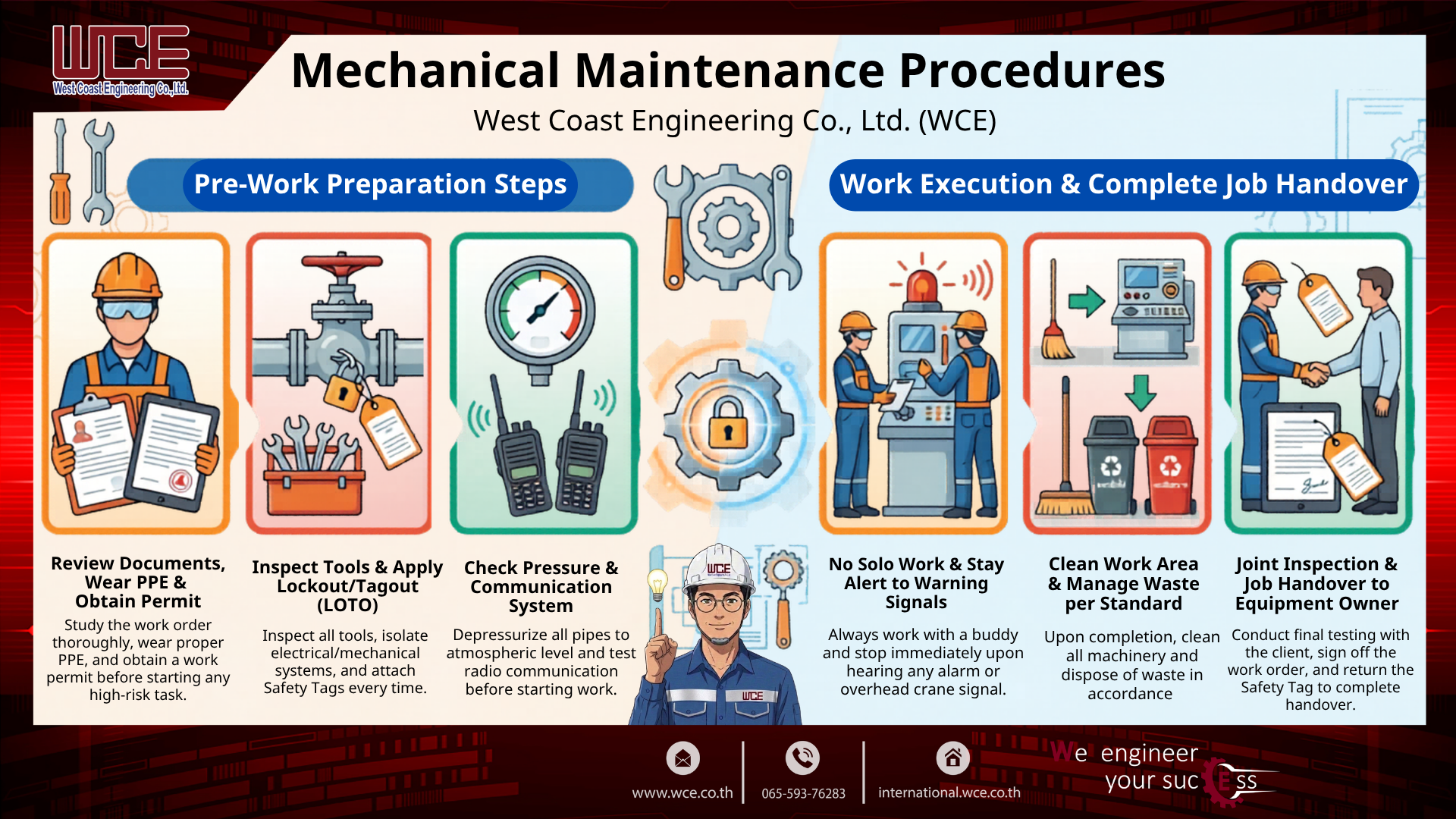
1. Review Documents, Wear PPE & Obtain a Work Permit
It sounds basic, but this is the step that sets everything else up for success. Technicians must read and fully understand their work orders, wear all required **personal protective equipment (PPE)**, and obtain a **work permit** from the area supervisor for any task that carries risk. No shortcuts, no exceptions.
2. Inspect Tools & Apply Lockout/Tagout (LOTO)
Every single tool must be inspected and confirmed in working condition before use. Then comes one of the most important safety steps in any maintenance environment: **lockout/tagout (LOTO)**. All electrical and mechanical energy sources must be isolated, and safety tags must be physically attached before anyone enters the work zone. This prevents accidental machine startup while a technician is working.
3. Check System Pressure & Confirm Communications
For any work involving pressurized systems, pressure must be fully released to the atmospheric level before proceeding. At the same time, radio communication must be tested and confirmed between all team members. In industrial environments, clear communication isn’t a formality—it’s a safety requirement.
—
🔧 Phase 2: Execute the Work & Hand Over Properly
4. Never Work Alone & Stay Alert to All Warning Signals
This rule has no exceptions: no technician may work near machinery without a co-worker or supervisor present. And when any alarm sounds — whether a general announcement or an overhead crane signal — work stops immediately, no questions asked.
5. Clean the Work Area & Manage Waste to Standard
Job completion doesn’t mean walking away when the repair is done. Technicians must clean all machinery and the surrounding work area and dispose of all waste materials in accordance with the company’s waste management standards. A clean handover is part of the job.
6. Conduct Joint Inspection & Hand Over to the Equipment Owner
The final step belongs to the client. Technicians conduct a joint final test with the equipment owner, obtain a signature on the work order confirming acceptance, and return the safety tag to formally close out the job. This is how WCE ensures every engagement ends with confidence on both sides.
—
✅ Why WCE Takes These Steps Seriously
Because we believe **good maintenance starts with the right preparation**. Every procedure is reviewed and approved by safety officers, engineers, and department managers—ensuring that every job WCE delivers meets the highest standards for safety, compliance, and environmental responsibility.
“Great maintenance isn’t just about fixing what’s broken — it’s about working safely, meeting standards, and delivering with confidence.”
—
📞 Looking for a Professional Maintenance Team? Contact WCE
West Coast Engineering Co., Ltd.
Industrial Engineering & Maintenance Technology Specialists
– 🌐 Website: [www.wce.co.th](http://www.wce.co.th)
– 📞 Phone: 065-593-76283
– ✉️ International inquiries: [international.wce.co.th](http://international.wce.co.th)
We engineer your success.
