
Academic Article by West Coast Engineering Co., Ltd. (WCE) We engineer your success
Introduction: When “Stopping” Costs More Than You Think
As Thailand’s manufacturing sector accelerates its transition into the Industry 4.0 era, the ability to keep machinery running reliably has evolved far beyond the responsibility of a single maintenance department. It has become a strategic, organization-wide capability that directly determines competitiveness in the marketplace.
International studies suggest that unplanned downtime in manufacturing operations can cost up to USD 26,000 per hour [1]. In other words, a single hour of unplanned machine stoppage can erase financial value equivalent to an entire month’s maintenance budget. This is precisely why globally recognized frameworks such as Total Productive Maintenance (TPM) and the ISO 55000 series for asset management are being elevated from technical concerns to C-suite strategic priorities at leading organizations worldwide.
This article presents the six-step Standard Operating Procedure (SOP) for machinery maintenance that West Coast Engineering Co., Ltd. (WCE) applies in serving its industrial clients, and connects each step to internationally accepted principles. The aim is to demonstrate to executives and engineers alike that what may appear to be a routine technical workflow is, in fact, a powerful instrument of asset management.
Section 1: The Six-Step Maintenance Framework
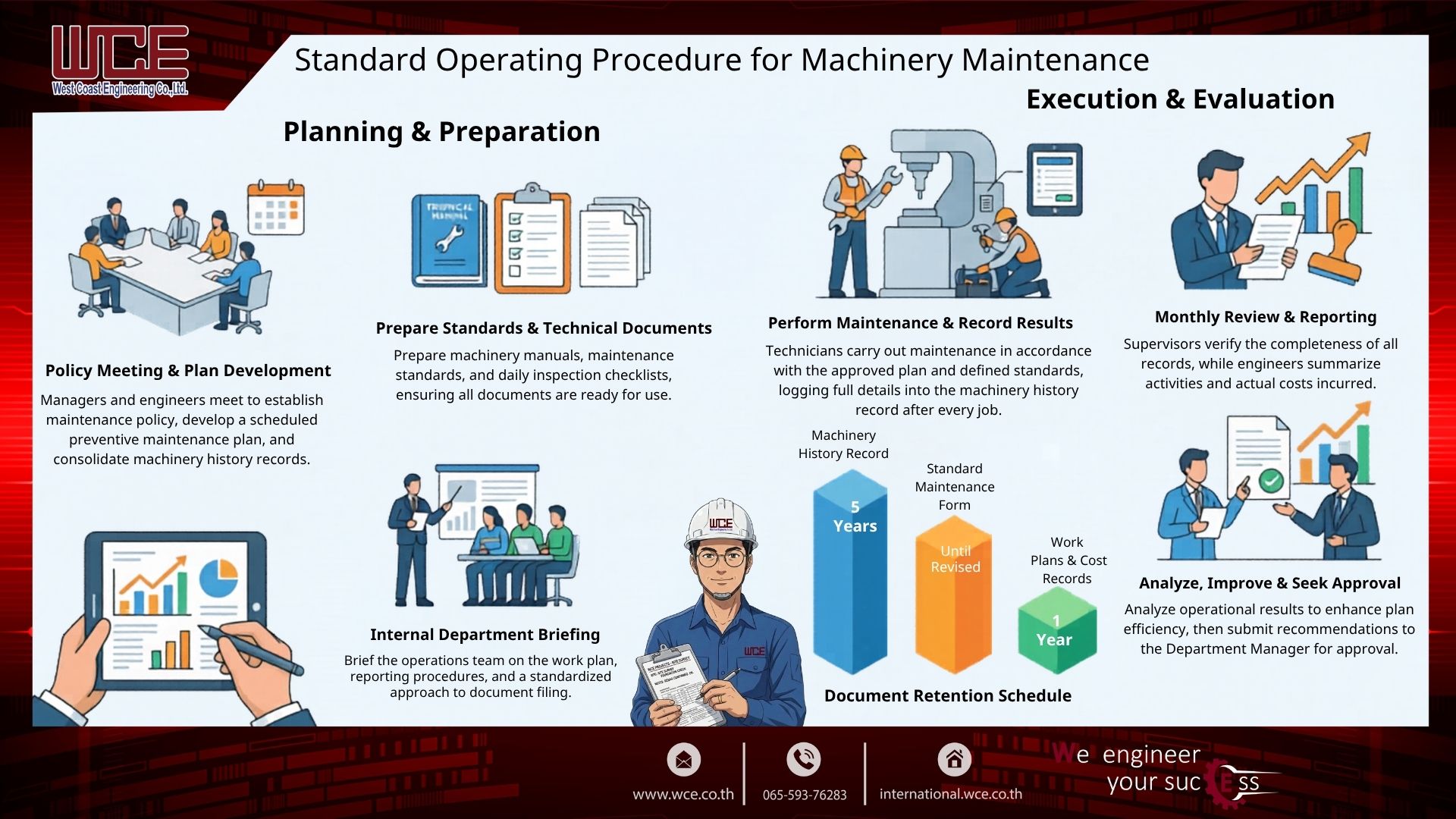
The standard procedure is organized into two principal phases, mirroring the PDCA Cycle (Plan-Do-Check-Act) that underpins modern quality management systems.
Phase 1: Planning & Preparation (Plan)
Step 1 — Policy Meeting & Plan Development Managers and engineers convene to establish maintenance policy, develop a scheduled Preventive Maintenance plan, and consolidate machinery history records. This step aligns directly with the principle articulated in ISO 55001, which holds that asset management must “begin with the alignment of asset objectives to the organization’s strategic objectives” [2].
Step 2 — Prepare Standards & Technical Documents Machinery manuals, maintenance standards, and daily inspection checklists are prepared and verified ready for use. These documents form the bedrock of standardization, one of the eight pillars of TPM. The methodology, originally developed at Nippon Denso in Japan during the 1970s, has been shown to substantially reduce variability in maintenance-work quality [3].
Step 3 — Internal Department Briefing The operations team is briefed on the work plan, reporting procedures, and document-filing standards. This cross-functional communication corresponds to the Education & Training pillar of TPM, which emphasizes that every participant in the maintenance process must clearly understand their role [4].
Phase 2: Execution & Evaluation (Do, Check & Act)
Step 4 — Perform Maintenance & Record Results Technicians execute work in accordance with the approved plan and defined standards, logging full details into the machinery history record after every job. This consistent record-keeping is the fundamental fuel for future Predictive Maintenance analysis, allowing failure modes to be analyzed and patterns identified over time.
Step 5 — Monthly Review & Reporting Supervisors verify the completeness of all records, while engineers summarize activities and actual costs incurred. This review aligns with the international practice of measuring Overall Equipment Effectiveness (OEE) — a primary KPI that evaluates equipment productivity across three dimensions: Availability, Performance, and Quality [5].
Step 6 — Analyze, Improve & Seek Approval Operational results are analyzed to enhance plan efficiency, with recommendations submitted to the Department Manager for approval. This “Act” step in PDCA is what distinguishes organizations stuck in a “firefighting” maintenance culture from those that achieve genuine Operational Excellence.
Section 2: Why Standardized Maintenance Delivers Measurable Results
Peer-reviewed research has demonstrated that adopting TPM and ISO 55000 frameworks for machinery maintenance delivers measurable, well-documented benefits.
A case study of an Active Pharmaceutical Ingredient (API) plant that implemented TPM reported a 33% reduction in planned maintenance activities, a 70% reduction in corrective maintenance, and a 20% increase in OEE in the pilot maintenance area within the study period [6]. Separately, a study of a small-scale polymer manufacturing operation found that OEE improved from approximately 75% to 83% after TPM implementation [7].
These outcomes mirror the core benefits of ISO 55001 certification highlighted by NQA, including the ability to reduce operational costs by extending the useful life of key assets, plan capital expenditures with greater accuracy, and lower workplace risk through improved equipment reliability [8].
Section 3: Records Retention — The Backbone of an Auditable System
One of the most frequently overlooked aspects of maintenance work is records management. WCE applies differentiated retention periods according to the nature of each document, balancing technical needs with the requirements of certified management systems.
| Document Type | Retention Period | Rationale |
|---|---|---|
| Machinery History Record | 5 Years | Used for analyzing failure patterns and lifecycle cost |
| Standard Maintenance Form | Until Revised | Active document used continuously |
| Work Plans & Cost Records | 1 Year | Supports annual budgeting and internal audit |
Disciplined records management of this kind is what enables an organization to support audits against ISO 9001, ISO 14001, and ISO 45001, and to satisfy the explicit “documented information” requirements of ISO 55001 [2].
Section 4: The WCE Approach — From Process to Commercial Outcome
At West Coast Engineering Co., Ltd. (WCE), we deliver machinery maintenance services to industrial clients across multiple sectors through our MET (Maintenance Engineering and Technology) business unit, working in close coordination with our other business units: MTE (Machinery Technology and Engineering), CTE (Construction Technology and Engineering), RAT (Robotics and Automation Technology), and RTE (Rail Technology and Engineering).
The principles that guide our practice are:
- Standardization First — Every job begins with a clear standard. We do not rely solely on individual expertise.
- Document Everything — Every maintenance activity is recorded, ensuring that our clients accumulate the historical data they need for future planning.
- Cycle of Improvement — Monthly reports are not bureaucracy; they are the engine of continuous plan optimization.
- Safety Is Non-Negotiable — Compliance with safety procedures, including PPE, Lockout/Tagout (LOTO), and Work Permits, is never optional.
This approach allows WCE to deliver maintenance services that meet international standards while remaining attuned to the specific realities of Thai industry — serving both production facilities that demand high reliability and executives who require predictability in budget planning.
Conclusion
Machinery maintenance in the 21st century is no longer a “back-of-house” function. It is a value-creation strategy with direct impact on cost structure, production reliability, and competitive positioning.
The six-step framework outlined in this article bridges internationally recognized principles (ISO 55000, TPM, OEE) with the practical realities of Thai industrial operations — a framework that WCE has used to deliver consistent reliability to its clients.
“Great maintenance is not just about fixing what is broken. It is about upholding standards, working safely, and delivering with confidence.”
References
[1] Comparesoft. (2025). Total Productive Maintenance: Striving For TPM Perfection and Maximising OEE. Retrieved from https://comparesoft.com/cmms-software/total-productive-maintenance-tpm/
[2] NQA. (2018). What is ISO 55001 Asset Management Certification?. Retrieved from https://www.nqa.com/en-us/resources/blog/march-2018/what-is-iso-55001
[3] Olanab Consults. (2024). Total Productive Maintenance (TPM) in Manufacturing Explained. Retrieved from https://www.olanabconsults.com/articles/total-productive-maintenance-tpm-in-manufacturing-explained
[4] MaintainX. (2024). Total Productive Maintenance: Boost Manufacturing Efficiency. Retrieved from https://www.getmaintainx.com/learning-center/total-productive-maintenance
[5] Vorne. Total Productive Maintenance (TPM) and OEE. Retrieved from https://www.vorne.com/learn/key-concepts/total-productive-maintenance/
[6] Hannon, D., et al. (2023). A total productive maintenance & reliability framework for an active pharmaceutical ingredient plant utilising design for Lean Six Sigma. PMC – National Library of Medicine. Retrieved from https://www.ncbi.nlm.nih.gov/pmc/articles/PMC10590851/
[7] Facilio. (2025). Total Productive Maintenance (TPM): Boost Uptime & Quality. Retrieved from https://facilio.com/learn/total-productive-maintenance/
[8] Bagleea, et al. (2017). ISO 55000 Standard as A Driver for Effective Maintenance Management. International Conference on Maintenance Engineering, IncoME-II. University of Manchester / University of Sunderland Repository. Retrieved from https://sure.sunderland.ac.uk/10107/
[9] Glomacs. (2025). How ISO 55000 Supports Maintenance and Asset Management Excellence. Retrieved from https://glomacs.com/articles/how-iso-55000-supports-maintenance-and-asset-management-excellence
Contact WCE — Your Engineering Partner of Choice
West Coast Engineering Co., Ltd. Integrated Manufacturing Engineering, Maintenance, and Industrial Technology Services
Business Units: MET | MTE | CTE | RAT | RTE
🌐 Website: www.wce.co.th 🌐 International Site: international.wce.co.th 📞 Phone: +66 (0) 65-593-76283 📧 Email: international@wce.co.th
We engineer your success.
