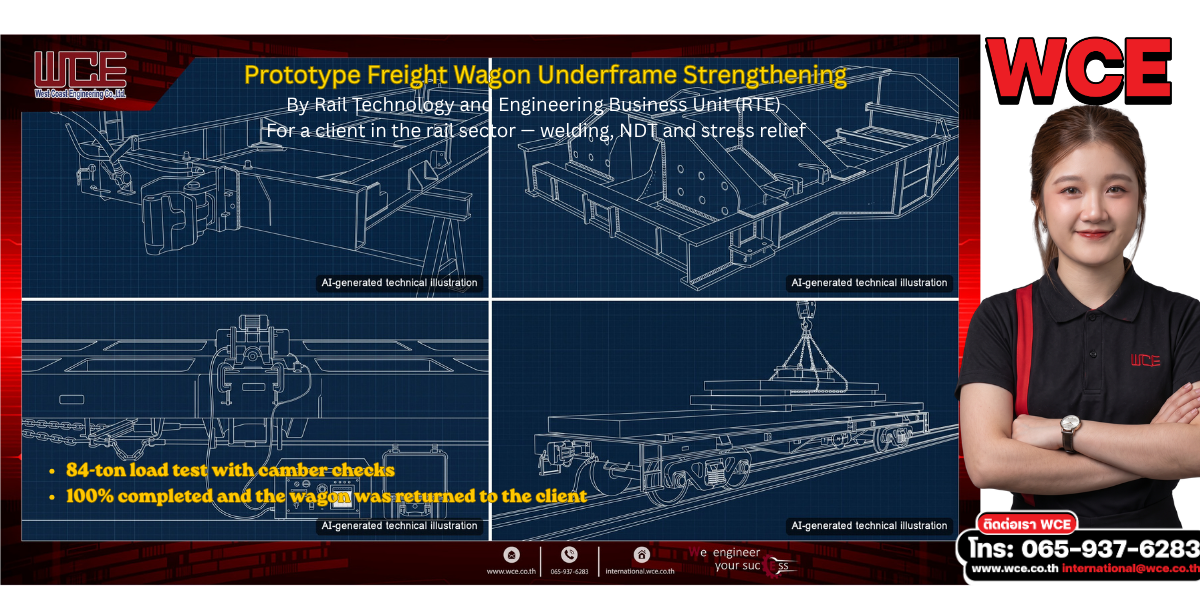
The underframe is the main structure beneath a freight wagon. It carries the cargo load, and the train forces throughout the wagon’s life. Wagon underframe strengthening adds capacity or extends the life of an existing frame. This article explains the main steps and the tests that confirm the result. It also presents a prototype wagon project by WCE’s RTE Business Unit.
A freight wagon underframe carries cargo weight, coupler pull and buff forces, and running loads. EN 12663-2 defines the load cases a wagon body must withstand. It also requires design validation by analysis and testing [1].
Welding new plates onto the existing frame increases the load-bearing section. As a result, the owner avoids building a new frame. However, welds on rail vehicles carry repeated loads for many years. For this reason, weld quality needs strict control.
Welding reinforcement plates
Welders join new steel plates to the beams of the existing underframe. Rail vehicle welding has its own standard series, EN 15085. It covers every welded part of a rail vehicle [2].
Non-destructive testing (NDT)
Next, the team inspects the welds with NDT methods. These methods find hidden flaws without damaging the part. ISO 17635 gives the general rules for choosing NDT methods and testing levels for metal welds [3].
Vibratory stress relief
Welding leaves residual stress in the steel. In this method, a vibrator clamps onto the structure and runs at a controlled frequency. It suits large parts that cannot fit in a furnace. A theoretical review explains how vibration relaxes and stabilizes residual stress in large welded fabrications [4].
The final step is a full load test. The team places test weights on the wagon and then measures how the underframe deflects.
Camber is the slight upward curve built into an underframe. Engineers measure it under load and again after unloading. In this way, they confirm that the frame springs back without permanent deformation.
Working on a single prototype with a real load test is a sound way to prove a strengthening method. After that, the method can be applied to more wagons.
Cover image (top left to bottom right): reinforcement plates welded to the underframe; weld seams ready for NDT; the vibratory stress relief setup; and the load test with steel plates. All images are AI-generated technical illustrations, not photos from the actual site.
WCE’s RTE Business Unit provides rail engineering services. These include rolling stock maintenance, parts supply, maintenance equipment fabrication and structural strengthening of wagons.
📞 Tel: +66 65-937-6283 | 📧 Email: international@wce.co.th | 🌐 Website: www.wce.co.th
We engineer your success.
References
[1] CEN. (2010). EN 12663-2:2010 Railway applications – Structural requirements of railway vehicle bodies – Part 2: Freight wagons.
[2] CEN. (2023). EN 15085-1:2023 Railway applications – Welding of railway vehicles and components – Part 1: General.
[3] ISO. (2025). ISO 17635:2025 Non-destructive testing of welds – General rules for metallic materials.
[4] Walker, C. (2011). A theoretical review of the operation of vibratory stress relief with particular reference to the stabilization of large-scale fabrications. Proceedings of the IMechE, Part L, 225(3), 195–204.
Accessed 14 October 2026

