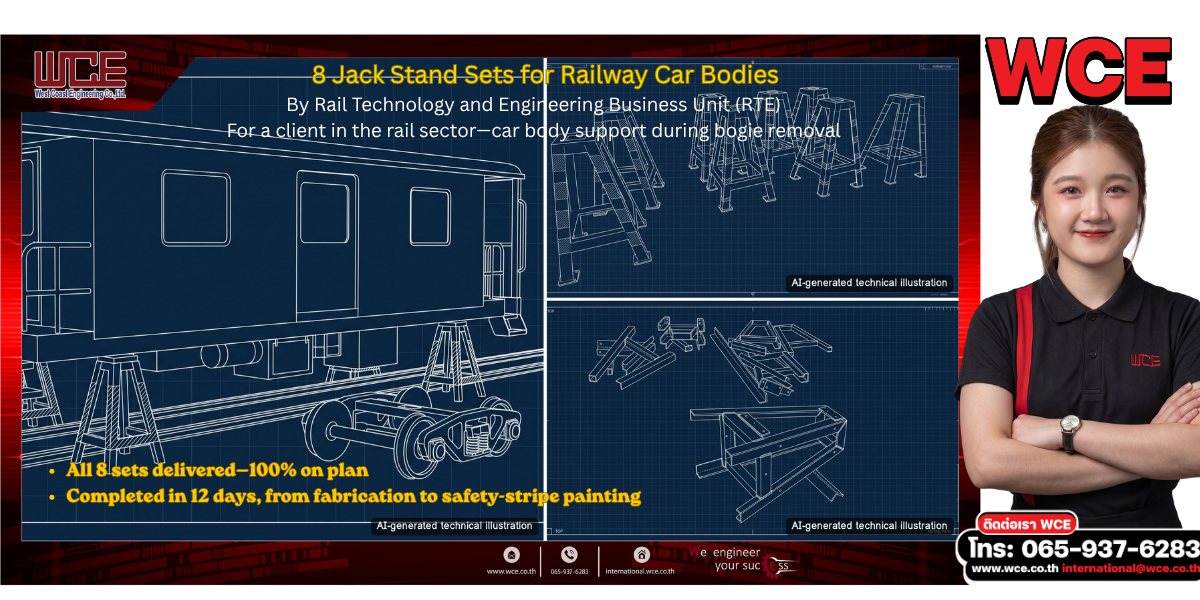
Railway jack stands hold a car body safely while its bogies are removed for maintenance. First, workers lift the car body with jacks. Next, they place the stands under the support points. Finally, they lower the body onto the stands and roll the bogies out. This article explains how these stands work and what makes them safe. It also presents a case study of eight sets built by WCE’s RTE Business Unit.
A jack stand is a steel frame that carries the car body in place of the bogie. It is a temporary support during repair work. The body should rest on stands rather than stay on jacks. In this way, a leaking or sinking jack cannot drop the load. For this reason, ASME PASE sets safety requirements for this type of stand [1].
In addition, EN 16404 defines how lifting equipment meets a rail vehicle. Contact happens at jack contact faces or lifting bracket areas on the vehicle structure [2]. The same principle applies to railway jack stands. They must sit only at load-bearing points of the car body.
Strength and stability
Each stand needs a capacity well above the load it will carry. Its base must be wide enough to resist tipping. Also, it must stand on flat, firm ground [1].
Weld quality
Workers build the frame from welded structural steel sections. Structural steel welding commonly follows AWS D1.1. The code covers weld details, welder qualification, and inspection [3].
Visibility and safety
Alternating hazard stripes make the stands easy to see in a busy workshop. As a result, people are less likely to bump or misplace them. ISO 3864-1 sets the design principles for safety markings like these [4].
The team cut and welded steel sections into tapered stand frames. Each frame has lower cross members for extra rigidity. Then the team painted hazard stripes on every leg. Finally, the client received the stands for its maintenance work.
Cover image (left to right): a car body resting on stands with its bogie removed; the eight finished stands with hazard stripes; and a welded steel frame during fabrication. All images are AI-generated technical illustrations, not photos from the actual site.
Support equipment such as railway jackstands is a small job. However, it directly affects the safety of workers under the car body. A team that understands rail maintenance can deliver ready-to-use equipment quickly. In this project, all eight sets were delivered within 12 days.
WCE’s RTE Business Unit provides rail engineering services. These include rolling stock maintenance, parts supply, and fabrication of maintenance support equipment.
📞 Tel: +66 65-937-6283 | 📧 Email: international@wce.co.th | 🌐 Website: www.wce.co.th
We engineer your success.
References
[1] ASME. (2024). ASME PASE-2024 Safety Standard for Portable Automotive Service Equipment.
[2] CEN. (2016). EN 16404:2016 Railway applications—Re-railing and recovery requirements for railway vehicles.
[3] American Welding Society. (2025). AWS D1.1/D1.1M:2025 Structural Welding Code – Steel.
[4] ISO. (2011). ISO 3864-1:2011 Graphical symbols—Safety colours and safety signs – Part 1: Design principles for safety signs and safety markings.
Accessed 14 October 2026

