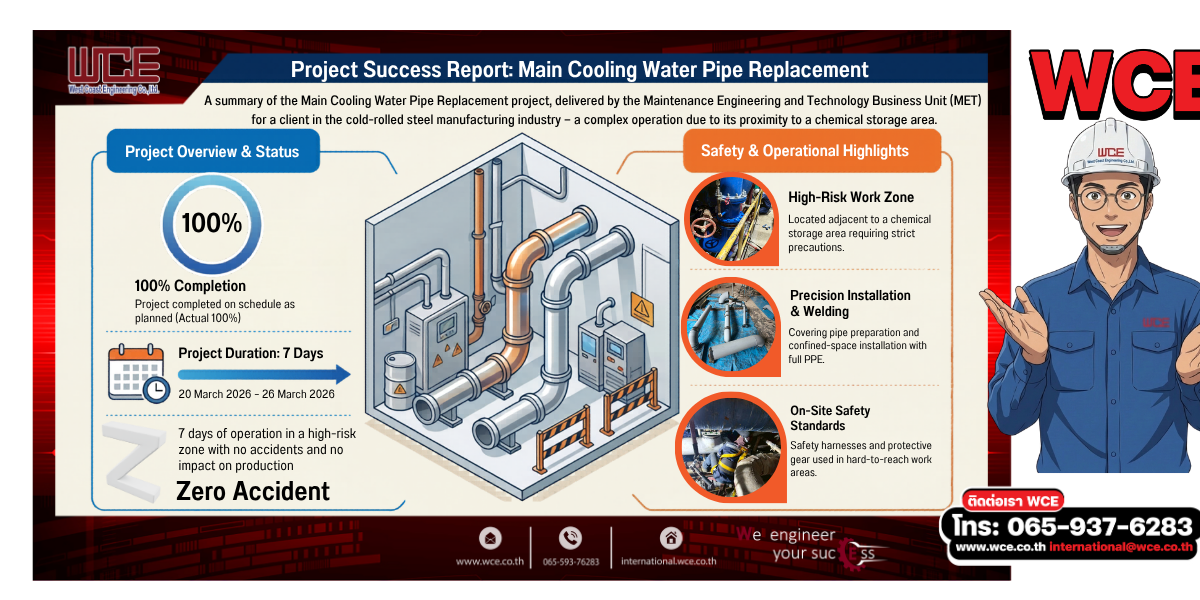
The cooling water system is a critical infrastructure component in cold-rolled steel manufacturing. Plant shutdowns for replacing or maintaining main pipelines, therefore, demand precise engineering planning and high-level risk management. This article presents principles for managing main cooling water pipe replacement projects under tight timeframes, in environments exposed to risks arising from proximity to chemical storage areas, by applying pre-fabrication (modular piping construction), risk assessment, and effective plant shutdown management. A field case study from actual operations in Thailand’s cold-rolled steel sheet industry is presented.
Keywords: Cooling Water System, Pre-fabrication, Risk Assessment, Plant Shutdown, Maintenance Engineering, Hazardous Area
In the cold rolling mill industry, the cooling water system regulates the temperature of rolls, work-in-progress steel, and mechanical equipment along production lines. The stability of this system directly affects product quality, machinery safety, and production continuity (Nayyar, 2000). When main pipelines reach the end of their service life or sustain damage, replacement must be executed within a constrained plant shutdown window, as prolonged downtime represents significant economic loss to operators.
The challenges of pipe replacement projects in industrial plants therefore extend beyond welding and assembly techniques alone, encompassing time management, safety management in complex work areas, and coordination with other utility systems that remain in operation.
The Process Safety Management standard of OSHA, 29 CFR 1910.119, requires that work conducted in areas adjacent to hazardous chemicals undergo systematic risk assessment, covering hazard identification, impact analysis, and the establishment of control measures (OSHA, 2024). Similarly, ISO 45001:2018 mandates that organisations integrate occupational health and safety management into every step of their operational processes (ISO, 2018).
Work in such areas therefore requires a Job Safety Analysis (JSA) prepared before each work phase, along with a Permit-to-Work (PTW) system for high-risk activities such as hot work, confined space entry, and working at height.
The ASME B31.3 Process Piping Code (ASME, 2022) specifies requirements for the design, installation, and inspection of piping systems in industrial processes, particularly pipe routing, which must account for safe clearance from other piping systems, pipe support, and thermal expansion.
In work areas where existing utility piping is densely installed, operators must possess highly precise fitting and welding skills, with plans in place to prevent disturbance to adjacent systems that remain in operation.
Pre-fabrication is the process of preparing and assembling pipe components — such as elbows, flanges, and spool pieces — at an off-site facility under controlled environmental conditions before transporting them to the work site for installation (Smith & Van Laan, 1987).
Research by the Construction Industry Institute (2013) indicates that applying modularisation principles can reduce on-site construction time by 30–40%, reduce labour exposure in high-risk areas, and improve weld quality due to work being performed in controlled environments. The safety engineering benefits of prefabrication, therefore, include four key aspects:
Before commencing work in hazardous areas, the engineering team must prepare JSA documentation specifying all work steps, potential hazards at each step, and preventive measures (OSHA, 2024) in coordination with the client plant’s safety department to define conditions for isolation of chemical systems and appropriate buffer zones.
Effective plant shutdown management requires work planning using the Critical Path Method (CPM) to identify activities determining the overall project duration and to allocate resources in alignment with work sequencing (Nayyar, 2000). This approach enables the parallel execution of multiple workstreams — such as demolition of existing piping, transportation of pre-fabricated components, and weld point preparation — within the limited timeframe.
The Maintenance Engineering and Technology (MET) Business Unit of West Coast Engineering Co., Ltd. (WCE) executed a Main Cooling Water Pipe Replacement project for a publicly listed cold-rolled steel sheet manufacturer in Thailand between 20 and 26 March 2026 (a total duration of 7 days).
Project Context:
Approach Applied:
Results:
The project was delivered at 100% of plan within the 7-day window, with zero safety incidents recorded. The cooling water system returned to operation on schedule, fully preserving the client’s production continuity.
The replacement of main cooling water piping in cold-rolled steel industrial plants exemplifies the integration of multiple engineering disciplines — including piping engineering, safety engineering, and project management.
The application of prefabrication principles, combined with systematic risk assessment and critical path planning, can significantly reduce on-site working time, mitigate risks in hazardous areas, and increase delivery reliability. The presented case study demonstrates that even under the most challenging conditions — confined space, dense piping, proximity to chemicals, and a 7-day window — adherence to internationally recognised engineering principles can deliver projects safely and on schedule.
West Coast Engineering Co., Ltd. (WCE) is a comprehensive engineering services provider in the heavy industry sector, covering machinery engineering, industrial plant maintenance management, steel structure fabrication and assembly, Engineering Procurement and Construction (EPC), railway engineering, and robotics and automation systems.
The Maintenance Engineering and Technology (MET) Business Unit specialises in preventive maintenance engineering, plant shutdown maintenance, and risk management in hazardous areas, with direct experience serving publicly listed steel manufacturing facilities.
We engineer your success.
📞 Phone: 065-937-6283 📧 Email: international@wce.co.th 🌐 Website: www.wce.co.th
#IAMWCE | #WestCoastEngineering | #MET | #MaintenanceEngineering

