Hydraulic oil stations in steel plants run on high-pressure oil all day. If a line leaks, the oil can spray out as a mist and catch fire. For this reason, a fixed fire protection system is a key safeguard in these areas. This article explains the fire risk of hydraulic oil and how fixed water spray systems work. It also covers testing before use. Finally, it presents a case study: hydraulic oil fire protection installed by WCE’s MET business unit.
Hydraulic and lube oils can operate at pressures up to about 10,000 psi. When a leak occurs, the oil escapes as a fine spray or mist. This mist can ignite on contact with hot surfaces, open flames, or electric arcs. The resulting fire behaves like a torch and is hard to control [1]. In addition, research by the UK Health and Safety Executive shows that small leaks from pressurized equipment can release jets of oil droplets. Many types of industrial equipment can do this if a fault develops [2].
NFPA 15 sets minimum requirements for the design, installation, and acceptance testing of water spray fixed systems. These systems provide fire control, extinguishment, prevention, or exposure protection [3].
A typical system has fixed supply piping, spray nozzles placed over the hazard and a valve set that controls the water supply [3]. In practice, the piping also needs firm supports. Meanwhile, the nozzle positions must match the equipment the system protects.
Plants can also switch to less hazardous hydraulic fluids. FM Approvals rates fluids by their Spray Flammability Parameter. Approved fluids do not need extra sprinkler protection. However, some other fluid classes may still require it [1].
A hydrostatic test is an important step before handover. For example, NFPA 13 tests sprinkler piping at 200 psi (14 bar). The system must hold this pressure for 2 hours without loss [4]. Actual criteria depend on the system type and the owner’s requirements.
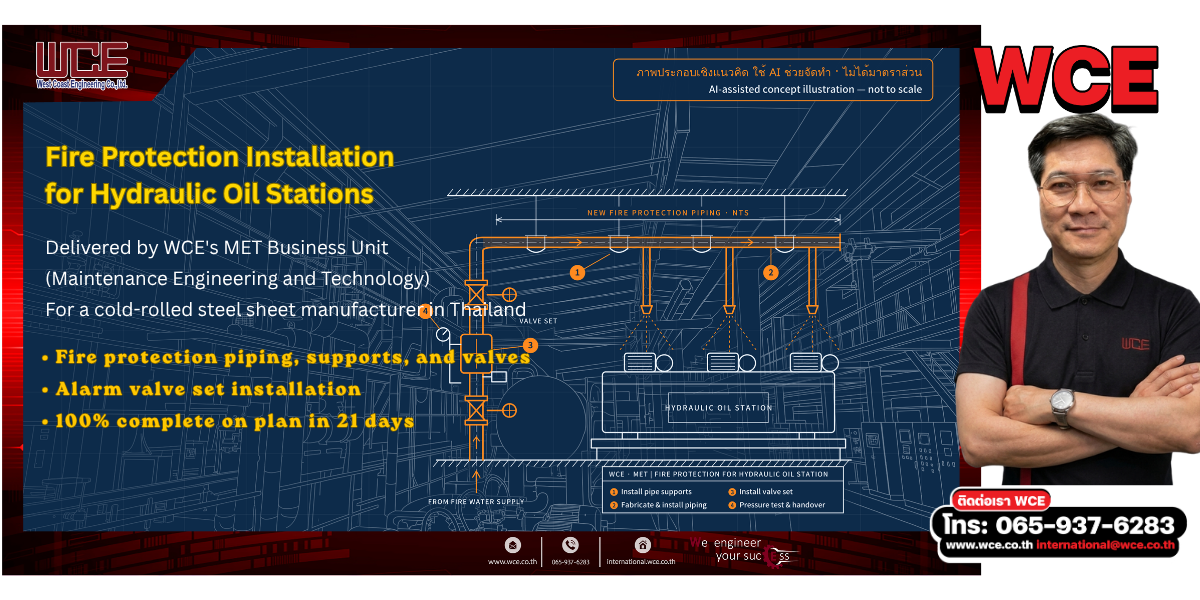
This project drew on MET’s expertise in fire protection piping inside operating plants. First, the team installed the pipe supports. Next, it fabricated and installed the piping and fitted the valve set. Finally, the team tested the system before handover. As a result, the work finished on the plan in 21 days.
The cover image is a concept illustration. In the background, a perspective line drawing shows the hydraulic station area. On the right, a diagram traces the supply line from the valve set up to the main pipe. Branch lines then drop to spray nozzles over the hydraulic oil station. An orange highlight marks the new piping and valves. The four work steps complete the drawing. All images were created with AI assistance, so no person or client can be identified.
Installing fire protection in a crowded equipment area takes careful routing. The piping must clear existing structures and machines. In addition, every support must hold the line firmly. For this reason, a clear work sequence from the start helped the team finish the installation and testing on schedule.
WCE’s MET (Maintenance Engineering and Technology) business unit provides maintenance for industrial machinery and plant systems. Its services include fire protection piping and high-pressure piping work.
Contact: +66 65-937-6283 | international@wce.co.th | www.wce.co.th
We engineer your success.

