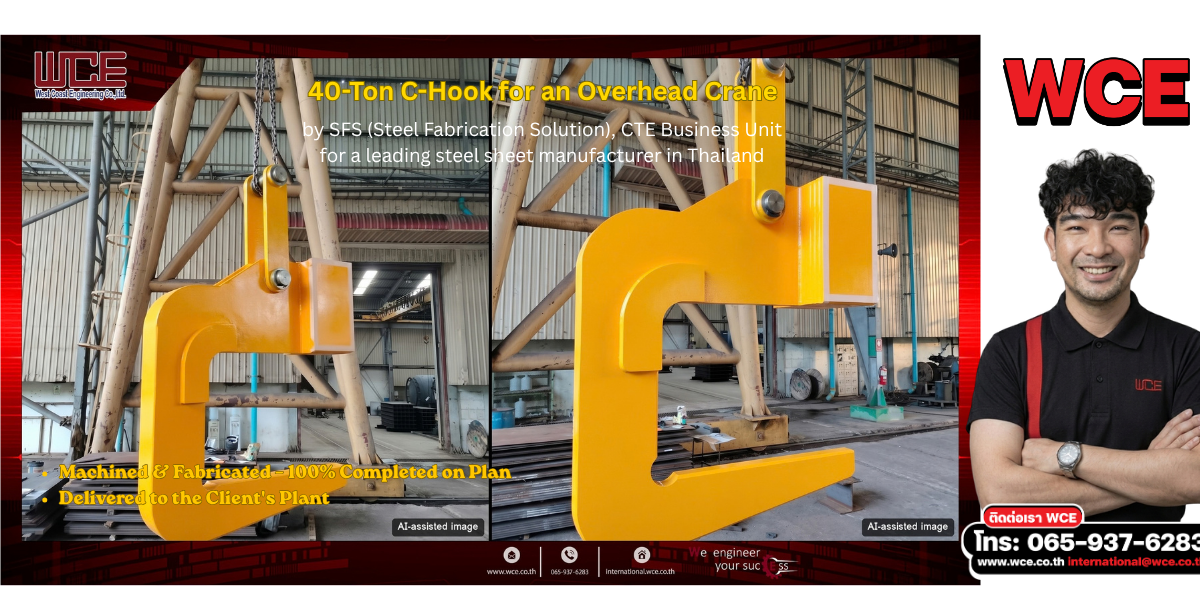
A C-hook is a lifting device that hangs below a crane hook. Steel plants use it to lift items with a central opening, such as steel coils. Specific standards cover the design, marking, and inspection of these devices. This article first explains the principles using standards and technical sources. It then presents a case study: a C-hook for a 40-ton overhead crane, built by SFS (Steel Fabrication Solution), part of WCE’s CTE business unit.
A C-hook is a C-shaped lifting device. Operators insert its lower carrying arm into the inner diameter of a coil. The crane then lifts the coil. One manufacturer describes C-hooks as counterbalanced, so they hang level whether loaded or unloaded. In addition, many designs include pads that protect the coil surface [1].
ASME B30.20 covers structural and mechanical below-the-hook lifting devices. It addresses marking, construction, installation, inspection, testing, maintenance, and operation [2]. Meanwhile, ASME BTH-1 covers design. It includes lifting device classifications, structural design, and mechanical design [3].
BTH-1 classifies each device by design category and service class [3]. According to one lifting equipment manufacturer, Design Category B applies to unpredictable or severe loading conditions. It requires a minimum 3:1 design factor. In contrast, the service class reflects the number of load cycles over the device’s life. As a result, it relates to fatigue [4]. For example, some mill-duty C-hooks follow Category B, Service Class 3 or 4 [1].
Every below-the-hook device must carry a mark showing its rated load. In addition, users must inspect it regularly. Inspections range from visual checks before each use to periodic inspections at least once a year. Under severe service, inspections should happen more often [4].
The cover image shows the finished, painted C-hook hanging in a workshop. On the left, you can see the whole device with its lifting link and pins. On the right, the image shows the hook body in closer detail. We edited all images with AI so that no individuals or clients can be identified.
SFS (Steel Fabrication Solution), part of the CTE business unit, provides steel fabrication and machined components for industrial plants.
To discuss your project: +66 65-937-6283 | international@wce.co.th | www.wce.co.th
We engineer your success.
(Accessed 6 Oct 2026)
[1] Bushman Equipment. C-Hooks (manufacturer brochure). https://www.bushman.com/wp-content/uploads/files/pdf/below-the-hook/brochures/bushman-c-hooks-brochure.pdf
[2] ANSI Blog (5 August 2025). ASME B30.20-2025: Below-the-Hook Lifting Devices. https://blog.ansi.org/ansi/asme-b30-20-2025-below-hook-lifting-devices/
[3] ASME (2023). ASME BTH-1–2023 Design of Below-the-Hook Lifting Devices (table of contents). https://www.asme.org/getmedia/92e0982b-1a65-4a8d-9009-7342b004e00f/BTH-1_2023_ToC.pdf
[4] Brozyna, H. (5 October 2020). Understanding Safety and Design Requirements of Below-the-Hook Lifters. CMCO (manufacturer article). https://cmco.com/en-us/resources/blog/understanding-safety-and-design-requirements-of-below-the-hook-lifters

