Automotive parts makers must test every unit before shipment to prove it meets the car maker’s requirements. When those requirements change, the automated test station must change too. This article explains the role of end-of-line testing and the principles of test software and PLC control. It also shows how an existing station can be upgraded without buying new equipment. Finally, it presents a test station upgrade case study by WCE’s RAT business unit.
End-of-line testing checks every unit before it leaves the plant. An automated system runs the same test on each unit, so it reduces operator error. In addition, it catches defects before they reach customers. It also records test data for trend analysis and process control [2].
A PLC controls the station’s sequence, from clamping the part to running devices and safety functions. IEC 61131-3 defines PLC programming languages. These include text-based Structured Text and graphical Ladder Diagram and Function Block Diagram. It also defines Sequential Function Chart for structuring sequences [1].
Test software measures electrical and mechanical values, such as current, time, and force or stroke. Next, it compares each value with set minimum and maximum limits. Then it gives a PASS or FAIL result. Therefore, when the car maker updates its specifications, the limits, sequence, or measuring method in the software must change to match.
Some brake calipers carry a motor, such as electric parking brakes where a motor drives a nut that pushes the caliper piston. In normal operation, the motor draws about 2–5 A, rising to about 17 A when it stalls. High current usually points to something restricting piston movement [3]. For this reason, current is one of the key values when testing this type of part.
If a station’s mechanics and instruments are still in good shape, it can often meet a new specification through software and PLC sequence changes. As a result, the upgrade costs far less time and money than a new station.
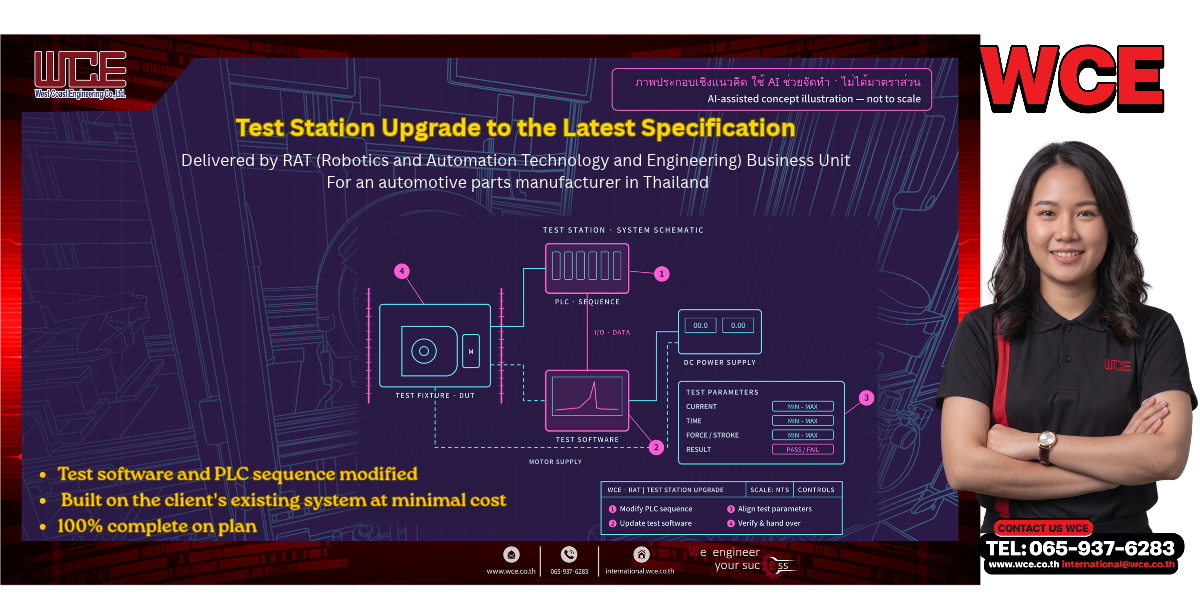
The client needed its test station to meet the car maker’s requirements and the latest R&D test specification. The RAT team built on the client’s existing system. First, it modified the PLC sequence. Next, it updated the test software to control the parameters to specification. Finally, the team verified the station before handover. As a result, the client gained a station that meets the latest specification at minimal cost.
The cover image is a concept illustration. In the background, a perspective line drawing shows the test station. On the right, a system diagram links the test fixture, PLC, test software, and power supply. A parameter table without real values sits beside it. Pink highlights mark the parts changed in this project, with the four work steps below. All images were created with AI assistance, so no person or client can be identified.
Automotive requirements change often. However, a team that understands both test software and PLC work can update an existing station quickly. Therefore, the client avoids long line stops and new capital spending.
WCE’s RAT (Robotics and Automation Technology and Engineering) business unit designs, upgrades, and develops automation systems, control systems, and test stations for industrial plants.
Contact: +66 65-937-6283 | international@wce.co.th | www.wce.co.th
We engineer your success.

