Summary
Sleepers on a railway bridge hold the rails to gauge and transfer train loads into the bridge structure. Traditional timber sleepers deteriorate with age and weather, so many railways are turning to more durable materials. This article explains the principles using technical sources, then presents the replacement of timber sleepers with steel sleepers on 14 railway bridges by BIS (Bridge and Infrastructure Solution), part of WCE’s CTE business unit, as a case study.
1. What do sleepers do on a bridge?
On an open-deck steel bridge, sleepers sit directly on the bridge girders with no ballast to spread the load, so they carry the full train load and must be strong enough to do so. Testing by the Transportation Technology Center (TTCI) found that not all timber bridge ties could withstand the recommended design load [1].
2. Key principles
2.1 Problems with timber sleepers
A review of sleeper failures identifies fungal decay, end splitting, and termite attack as key failure mechanisms for timber sleepers, leading to early replacement and high maintenance costs [2]. For timber transoms on an Australian bridge, researchers report renewal every 10-20 years due to humidity, salt spray, and dynamic loading [3].
2.2 Alternative materials and life cycle cost
Researchers have studied alternatives to timber on bridges, such as steel-concrete composite and fiber composite systems, with design lives of over 50 years [3], and have analyzed life cycle cost across manufacturing, installation, maintenance, and end-of-life. One study notes that maintenance makes up 25-35% of annual operating costs on Australian railway networks, so material choice strongly affects long-term cost [4].
2.3 Advantages of steel sleepers
A steel sleeper manufacturer states that steel sleepers typically last around 50 years, are light enough to transport in larger quantities, and are fully recyclable at end of life [5]. This is commercial information; actual service life depends on site conditions and maintenance.
3. Case study: steel sleepers on 14 railway bridges by BIS / CTE
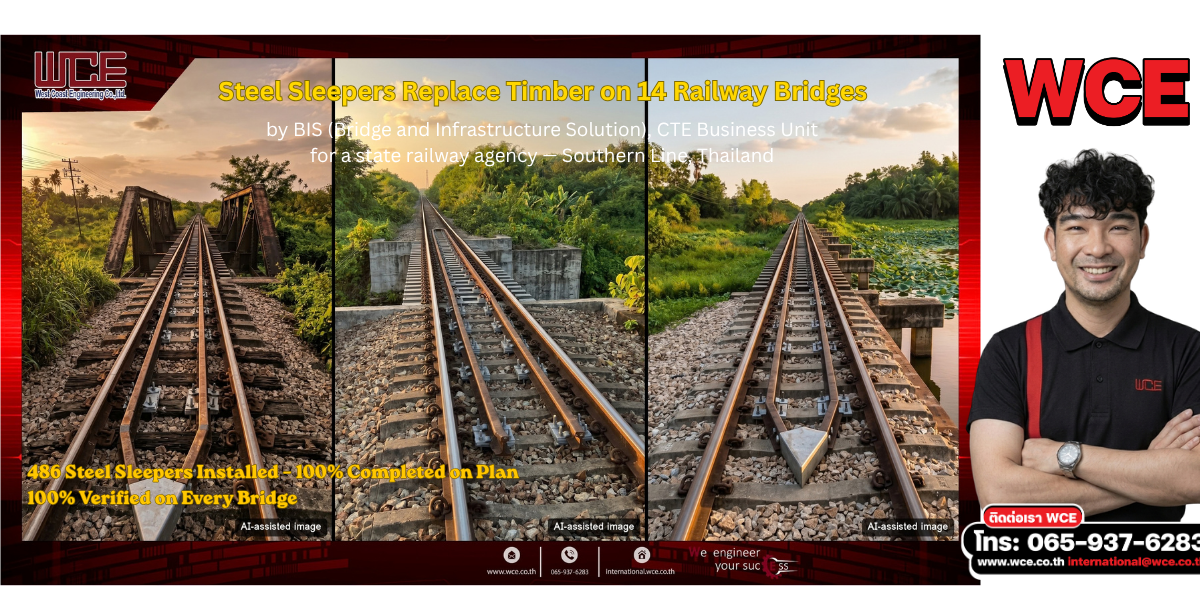
– Scope: Supply or manufacture of steel sleepers and replacement of timber sleepers on 14 steel railway bridges, 486 sleepers in total
– Example bridges: DP type 12 m, DG type 7×6 m, and TT type 25 m, each 100% installed
– Client: State railway agency
– Location: Southern Line, Thailand
– Duration: 30 October 2025 – 26 July 2026 (about 9 months)
– Progress: Plan 100% / Actual 100%, with 100% of work verified
The cover image shows installed steel sleepers on three bridge settings: from left to right, a steel truss bridge, a concrete bridge approach and a bridge over a pond. The timber sleepers visible in the foreground of the left image are on the embankment before the bridge and were outside this scope. All images were edited with AI so that no individuals or client can be identified.
4. Observations
Work on bridges of an operating railway must be planned around available track access, and this job was spread across many bridges in several areas. Verifying 100% of the work at every bridge was therefore a key step before handover.
5. WCE services
BIS (Bridge and Infrastructure Solution), part of the CTE business unit, provides bridge and infrastructure engineering, including railway work.
To discuss your project: +66 65-937-6283 | international@wce.co.th | www.wce.co.th
We engineer your success.
References (accessed 2 Oct 2026)
[1] Transportation Technology Center, Inc. (October 2011). Benchmark Testing of Timber Open Deck Bridge Ties. Technology Digest TD-11-036. https://www.mxvrail.com/wp-content/uploads/2023/01/TD11-036.pdf
[2] Ferdous, W., Manalo, A., Aravinthan, T. & Remennikov, A. (2014). Review of failures of railway sleepers and its consequences. Proceedings of the 1st International Conference on Infrastructure Failures and Consequences (ICFC 2014). https://research.usq.edu.au/item/q28x0/review-of-failures-of-railway-sleepers-and-its-consequences
[3] Mirza, O. & Kaewunruen, S. (2018). Resilience and Robustness of Composite Steel and Precast Concrete Track Slabs Exposed to Train Derailments. Frontiers in Built Environment, 4. https://doi.org/10.3389/fbuil.2018.00060
[4] Senaratne, S., Mirza, O., Dekruif, T. & Camille, C. (2020). Life cycle cost analysis of alternative railway track support material: a case study of the Sydney Harbour Bridge. Journal of Cleaner Production, 276, 124258. https://doi.org/10.1016/j.jclepro.2020.124258
[5] British Steel. Steel Sleepers (manufacturer product information). https://www.britishsteel.co.uk/what-we-do/rail/steel-sleepers/

