Wheels carry the vehicle’s load and touch the rail directly. For this reason, they are among the most safety-critical parts of any train. A solid rolled wheel is a single-piece steel wheel. Manufacturers form it by forging and rolling. Both passenger and freight vehicles use this type of wheel widely. This article explains the structure of solid rolled wheels and the quality principles behind them. It then presents a freight wagon wheel supply project by WCE’s Rail Technology and Engineering Business Unit (RTE).
Engineers also call a solid rolled wheel a monobloc wheel. Its hub, plate and rim come from one piece of steel, with no separate tyre. The American Public Transportation Association (APTA) defines “wrought” as a forging process that rolls metal into a disc-shaped part [2].
In Europe, EN 13262 sets the characteristics of solid forged and rolled wheels for all track gauges. It defines five steel grades: ER6, ER7, ER8, ERS8 and ER9. In addition, it covers wheels made from vacuum-degassed steel [1].
APTA defines the main parts of a wheel as follows [2]:
ASTM A504 requires rim quenching and shot peening for wrought carbon steel wheels. After that, the manufacturer finishes each wheel by rough boring and machining [3]. Rim quenching hardens the tread so it resists wear. Meanwhile, the rest of the wheel stays tough.
The same standard also calls for several checks [3]. First, a heat analysis confirms the chemical composition. Next, a Brinell test measures rim hardness. Finally, ultrasonic and magnetic particle methods check the wheel without damaging it. In addition, APTA requires the supplier to give the purchaser the results of all required tests [2].
Every wheel must carry identification marks. APTA prefers these marks on the front or back hub face whenever practical [2]. As a result, operators can trace each wheel back to its production lot and test results throughout its service life.
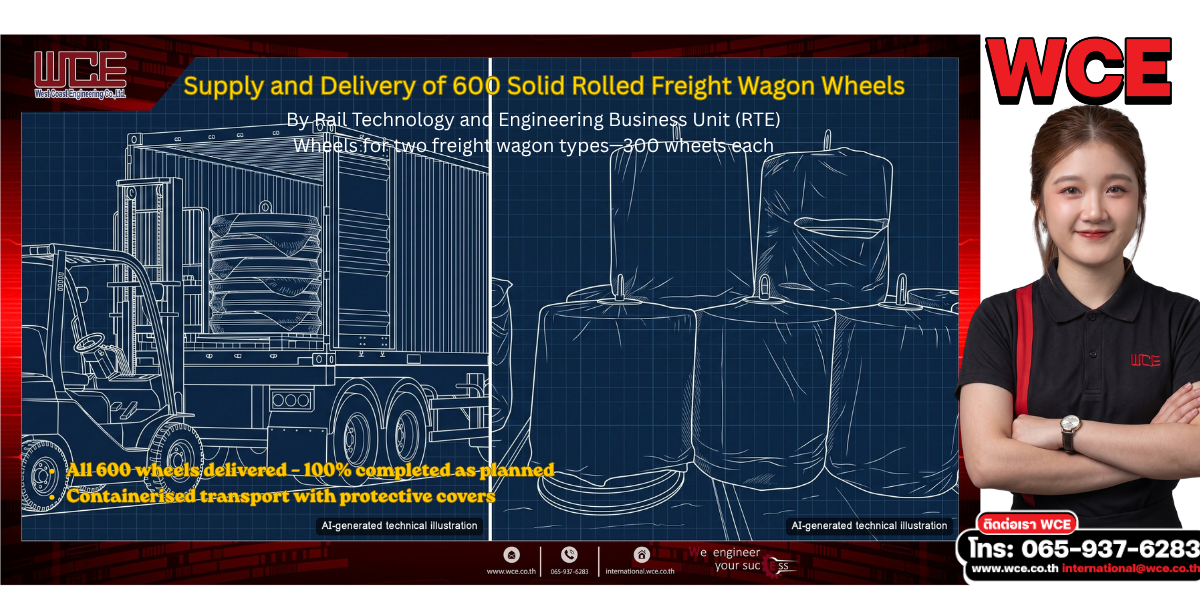
The cover image shows the delivery process. On the left, a forklift unloads wrapped wheels from a shipping container. On the right, wrapped wheel stacks stand in neat rows, ready for handover. AI created all images as technical illustrations. They are not site photographs, and they do not identify any person, client or location.
WCE’s Rail Technology and Engineering Business Unit (RTE) provides engineering, maintenance and component supply for railway rolling stock. We serve both passenger and freight fleets, from sourcing and transport through to delivery.
Contact: +66 65-937-6283 | international@wce.co.th | www.wce.co.th
We engineer your success.
[1] CEN. EN 13262:2020 Railway applications – Wheelsets and bogies – Wheels – Product requirements. https://www.sis.se/en/produkter/railway-engineering/railway-rolling-stock/general/ss-en-132622020/ (accessed 8 Oct 2026)
[2] American Public Transportation Association (APTA). APTA PR-M-S-012-99, Rev. 3: Manufacture of Wrought Steel Wheels. 2025. https://apta.com/wp-content/uploads/APTA-PR-M-S-012-99_R3.pdf (accessed 8 Oct 2026)
[3] ASTM International. ASTM A504/A504M-08(2013) Standard Specification for Wrought Carbon Steel Wheels. https://store.astm.org/a0504_a0504m-08r13.html (accessed 8 Oct 2026)

