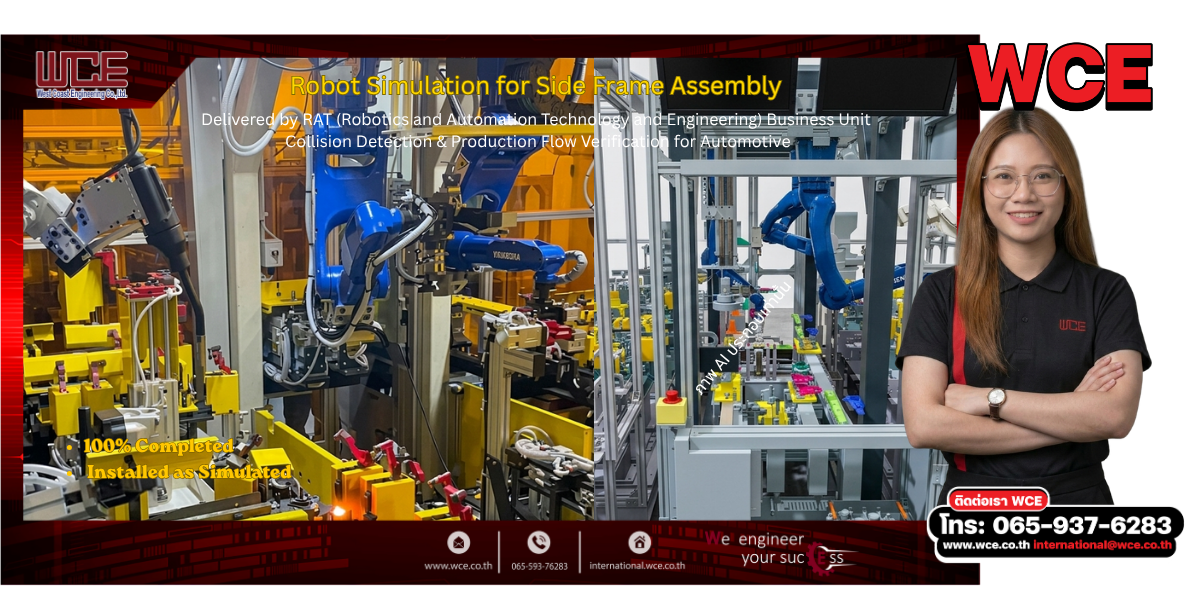
Modern automotive production lines employ multiple industrial robots working in close proximity within confined spaces, making thorough simulation essential before physical installation. Robot simulation verifies that robots and equipment operate without collision, that work sequences flow correctly, and that cycle times meet production targets. This is particularly critical for side frame assembly—a structurally complex automotive seat or body component requiring multi-robot coordination. This article examines robot simulation principles, collision detection methodology, automotive applications, and a real-world project reference demonstrating WCE’s capabilities.
Robot simulation is the process of creating 3D digital models of industrial robots, jigs/fixtures, conveyors, and the complete working environment to simulate motion, work sequences, and interactions between all equipment before physical installation and commissioning [1].
Robot simulation is a core element of virtual commissioning, enabling engineers to test, verify, and troubleshoot in a virtual environment before real-world deployment—reducing risk, saving time, and lowering commissioning costs [2].
Robot simulation encompasses several levels of analysis:
In automotive assembly lines, multiple robots operate in shared workspaces—welding robots, handling robots, and inspection robots working in alternation or simultaneously. Collisions between robots, or between robots and jigs/fixtures, pose serious risks: equipment damage, emergency production stoppages, safety hazards for personnel, and significant repair costs [4].
Simulation software employs collision detection algorithms that generate bounding volumes around every component, then calculate whether any volumes intersect during motion sequences. When potential collision points are identified, engineers adjust robot paths, work sequences, or equipment positions to eliminate the risk [5].
A Side Frame is a structural component used in automotive seat frames or body-in-white (BIW) structures, serving as the lateral support framework. The manufacturing process typically involves press forming, multi-point welding, and assembly with other components using multiple coordinated robots [6].
Side frame assembly presents several challenges: numerous weld points in confined spaces requiring multiple robots to work in alternation or concurrently; complex jig/fixture geometries that robots must navigate precisely; demanding cycle times driven by automotive industry takt time requirements; and the need for rapid program modification during model changeovers [6].
Robot simulation reduces commissioning time by 20–50% through virtual testing and problem resolution; prevents costly collision damage; optimizes cycle time before production start; supports offline programming to minimize production line downtime for teaching; and produces clear documentation of production flow and robot trajectories [7].
| Item | Details |
|---|---|
| Project Name | Robot Simulation for Side Frame Assembly Line |
| Client | Multiple automotive parts manufacturers |
| Business Unit | RAT — Robotics and Automation Technology and Engineering |
| Scope | 3D simulation for collision detection, production flow modeling, and delivery of simulation files for client’s production installation |
| Project Duration | 5 May – 5 July 2026 (2 months) |
| Status | 100% Completed on schedule |
1. Comprehensive Collision Detection The WCE team created a complete 3D simulation modeling all robot trajectories, jig/fixture positions, and equipment in the side frame assembly line. Every potential collision point was identified and resolved through path optimization.
2. Complete Production Flow Simulation The simulation covered the entire work sequence—from workpiece loading, through welding and handling operations, to finished part output—with full cycle time calculation.
3. Production Installed Exactly as Simulated The key achievement: the client installed the actual production line precisely matching the simulation model, with no additional modifications required—confirming the accuracy and reliability of WCE’s simulation work.
[1] Nof, S.Y. (2009). Springer Handbook of Automation. Springer-Verlag Berlin Heidelberg.
[2] Reinhart, G. & Wünsch, G. (2007). “Economic Application of Virtual Commissioning to Mechatronic Production Systems.” Production Engineering, 1(4), 371–379.
[3] Pan, Z., Polden, J., Larkin, N., Van Duin, S. & Norrish, J. (2012). “Recent Progress on Programming Methods for Industrial Robots.” Robotics and Computer-Integrated Manufacturing, 28(2), 87–94.
[4] Jiménez, P., Thomas, F. & Torras, C. (2001). “3D Collision Detection: A Survey.” Computers & Graphics, 25(2), 269–285.
[5] Ericson, C. (2004). Real-Time Collision Detection. Morgan Kaufmann Publishers, Elsevier.
[6] Nee, A.Y.C. & Ong, S.K. (2013). Virtual and Augmented Reality Applications in Manufacturing. Springer-Verlag London.
[7] Brogårdh, T. (2007). “Present and Future Robot Control Development — An Industrial Perspective.” Annual Reviews in Control, 31(1), 69–79.
WCE delivers robot simulation, collision detection, virtual commissioning, and offline programming services for automotive and all manufacturing industry production lines. Our experienced automation engineers ensure accurate, reliable simulation results.
📞 Tel: +66 65-937-6283 📧 Email: international@wce.co.th 🌐 Website: www.wce.co.th
We engineer your success.

