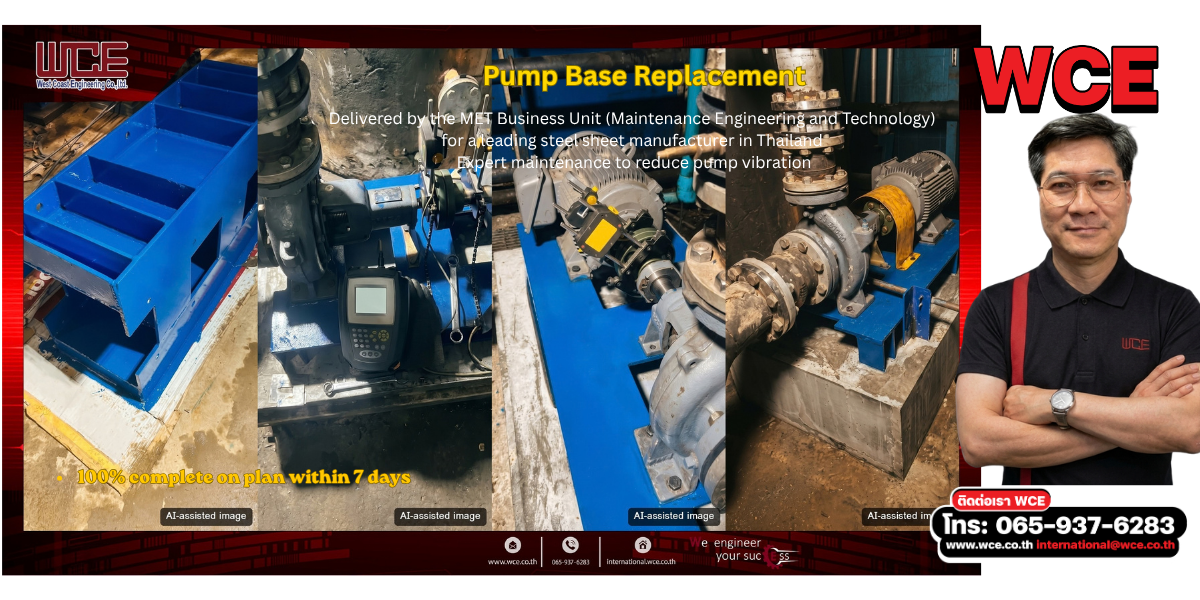
High vibration in pump-motor sets often comes from how the machine sits and lines up, not only from the pump itself. This article summarizes four relevant principles with cited sources: soft foot, shaft misalignment, baseplate installation and grouting, and vibration criteria. It then compares them with a case study. In this case, WCE’s MET business unit replaced a water pump base during a plant shutdown.
A pump baseplate holds the pump and motor in line on a concrete foundation. It also carries their weight and dynamic loads during operation. When the base degrades or sits poorly on its foundation, vibration typically rises. As a result, bearings and seals can wear faster.
Piotrowski (2010) [5] describes soft foot as one or more machine feet that do not make good contact with the base. This condition complicates shaft alignment and links to elevated 1x vibration. Therefore, correction starts with a flat base and feet that sit evenly before any shaft alignment [4][5].
Sekhar and Prabhu (1995) [6] used finite element modelling to study coupling misalignment. They showed that misalignment adds reaction forces and moments to the rotor system. In turn, it raises vibration harmonics. Meanwhile, Piotrowski (2006) [4] compiles alignment methods, including electro-optic (laser-based) techniques.
Many engineers reference API RP 686 [7] for machinery installation and epoxy grouting. In addition, a grout manufacturer’s technical bulletin [8] explains that grout should completely fill the space between the equipment and the concrete foundation. The bulletin also states that a bonded (“locked”) foundation system transfers load and dampens vibration better than an unbonded one. However, this is a manufacturer’s statement, so readers should consider it together with [7].
ISO 20816-1:2016 [1] gives general guidelines for measuring and evaluating machine vibration. Next, ISO 20816-3:2022 [2] applies to industrial machinery above 15 kW operating between 120 and 30,000 r/min. It replaces ISO 10816-3:2009. For rotodynamic pumps, ANSI/HI 9.6.4-2022 [3] covers measurement on bearing housings and allowable values for factory and field tests. Finally, the right criterion depends on machine type, power, and the agreement with the asset owner.
The facts in this section come from the project, not from the cited sources.
The cover image (AI-assisted, based on site photographs) shows four stages from left to right. First, you can see a newly fabricated and painted steel base. Next comes measurement with a vibration analyzer. Then, the team aligns the pump and motor shafts with a laser tool. Finally, the image shows the pump set on its new base and concrete foundation. This sequence mirrors sections 2.1 to 2.4: a correct base, installation, shaft alignment, and then measurement to confirm the result.
WCE’s MET business unit provides plant maintenance services, including preventive maintenance (PM), shutdown maintenance, and operation and maintenance (O&M).
Contact: +66 65-937-6283 | international@wce.co.th | www.wce.co.th
We engineer your success.
[1] ISO 20816-1:2016. Mechanical vibration – Measurement and evaluation of machine vibration – Part 1: General guidelines. International Organization for Standardization. https://www.iso.org/standard/63180.html
[2] ISO 20816-3:2022. Mechanical vibration – Measurement and evaluation of machine vibration – Part 3: Industrial machinery with a power rating above 15 kW and operating speeds between 120 r/min and 30 000 r/min. International Organization for Standardization. https://www.iso.org/standard/78311.html
[3] ANSI/HI 9.6.4-2022. Rotodynamic Pumps for Vibration Measurement and Allowable Values. Hydraulic Institute. https://webstore.ansi.org/standards/hi/ansihi2022-2481997
[4] Piotrowski, J. (2006). Shaft Alignment Handbook (3rd ed.). CRC Press. ISBN 978-1-57444-721-7.
[5] Piotrowski, J. (2010, May). Soft Foot: The First Step to Precision Alignment. Pumps & Systems. https://www.pumpsandsystems.com/soft-foot-first-step-precision-alignment
[6] Sekhar, A. S. & Prabhu, B. S. (1995). Effects of coupling misalignment on vibrations of rotating machinery. Journal of Sound and Vibration, 185(4), 655–671.
[7] American Petroleum Institute. API RP 686: Recommended Practice for Machinery Installation and Installation Design (2nd ed., 2009).
[8] Five Star Products, Inc. Technical Bulletin 419: Steel Baseplate Considerations. https://www.fivestarproducts.com/wp-content/uploads/TB419-SteelBaseplateConsiderations-na13568eng-rA.pdf
(Accessed 1 October 2026)

