Refractory materials are the heart of any industrial furnace. They let it run safely and efficiently at temperatures from several hundred to well over a thousand degrees Celsius. However, refractory linings degrade over their service life. As a result, refractory furnace maintenance, whether periodic repair or full relining, becomes a specialized task. It demands expertise in materials engineering, installation technique, and safety management in confined, high-temperature spaces. This article first explains the key principles. It then presents a real project reference from WCE’s MET business unit.
Refractory is a material engineered to keep its shape and mechanical properties at high temperature. It plays two roles at once. First, it resists heat, protecting the furnace’s steel structure from flames and thermal load. Second, it insulates, reducing energy loss so the furnace saves fuel and holds temperature accurately.
Without an intact refractory layer, direct heat reaches the furnace’s steel shell. This leads to deformation, hot spots, and potentially costly emergency shutdowns. Therefore, a service-ready lining directly affects safety, furnace life, and production efficiency.
Crews lay shaped refractory bricks to form furnace walls and floors. These bricks offer high mechanical strength and good abrasion resistance. For this reason, they suit areas that carry structural load or touch moving material.
These jointless materials are cast, poured, or gunned into place on site. They suit complex shapes and local repairs, and they install quickly. In addition, they remove the joints that often become weak points. As a result, castables are increasingly the material of choice for preventive maintenance.
These low-density materials have low thermal conductivity. Engineers use them as a backup insulating layer to minimize heat loss. Typically, they work together with the working lining in a multi-layer system.
Overall, engineers choose materials by properties such as refractoriness, thermal shock resistance, slag and chemical resistance, and abrasion resistance. They then match each choice to the actual conditions in each furnace zone.
Several mechanisms work together to wear down refractory linings. First, repeated expansion and contraction cause thermal spalling. Next, slag and process vapors cause chemical attack. In addition, moving material erodes and abrades the surface. Finally, melt can penetrate and weaken the material body.
Because of this, every lining has a finite service life. Teams must inspect and maintain it on schedule. Planning repairs during a suitable shutdown window reduces the risk of unplanned failure and extends furnace life.
First, the team surveys the lining and measures the remaining thickness. It then maps cracked, spalled, or thinned areas. This defines the scope of work and the right material for each zone.
Next, the team carefully removes only the damaged sections. It avoids disturbing the sound lining or the steel shell. This stage often takes place in a confined space, so strict dust and safety control is essential.
Then, the team cleans the contact surface and installs anchors for castable materials. As a result, the new lining bonds securely to the structure and handles expansion forces properly.
After that, the team lays brick or casts and guns castable material to the drawings and the manufacturer’s specifications. Meanwhile, it controls mix ratio, thickness, and joint quality to achieve a continuous, standard-compliant lining.
Finally, controlled heating drives moisture out of the castable along a specified heat-up curve. This is one of the most critical stages. If temperature rises too fast, trapped moisture turns to steam. The steam then builds internal pressure that can cause spalling or explosive failure (steam spalling). Therefore, correct control of temperature and hold times decides the quality and life of the new lining.
Refractory repair is a high-risk activity with strict safety standards. The most important is confined space entry, which requires atmospheric monitoring, ventilation, and a dedicated attendant. In addition, teams must control hot work and manage silica dust. They must also apply Lockout/Tagout (LOTO) to isolate furnace energy sources before entry. Ultimately, rigorous safety planning and specially trained crews make it possible to finish this work safely.
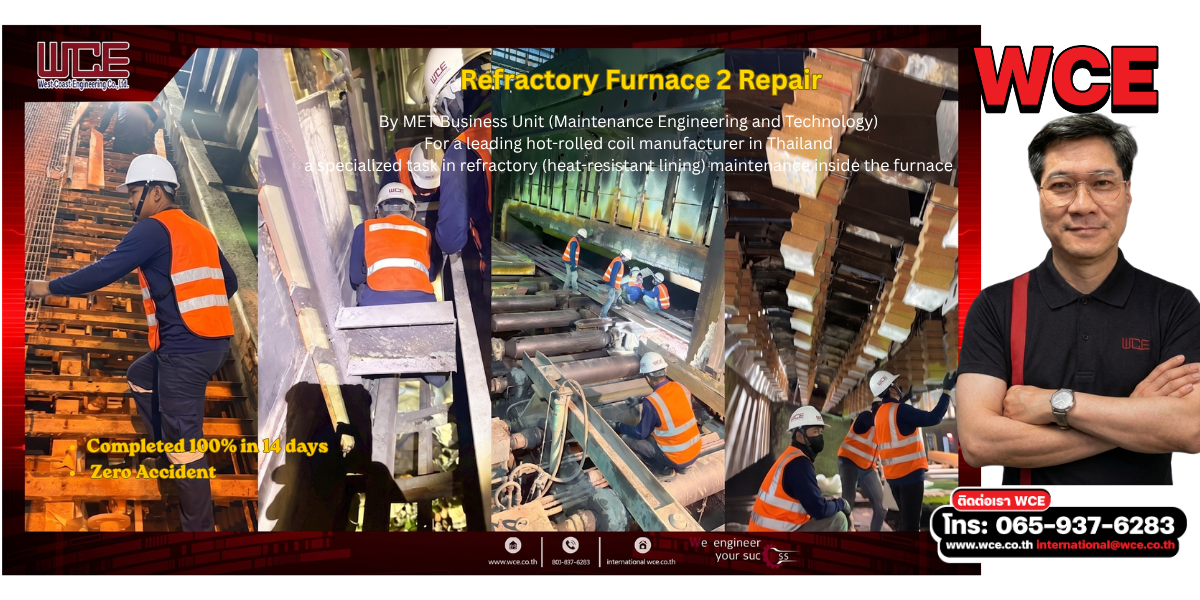
WCE’s MET (Maintenance Engineering and Technology) business unit repaired the refractory lining of an industrial furnace for a leading hot-rolled coil (HRC) manufacturer in Thailand. The task required specialized expertise in refractory maintenance inside the furnace.
First, the team inspected and assessed the lining. Next, it removed the damaged refractory and installed new material. Finally, it carried out a controlled moisture dry-out in line with engineering best practice. The team finished within the scheduled window, from 10 to 23 July 2026, a total of 14 days.
This project shows WCE’s readiness to deliver specialized maintenance engineering. It spans refractory materials, confined-space work, and safety management in demanding industrial environments.
WCE provides end-to-end industrial furnace maintenance, refractory services, and plant maintenance engineering. Our experienced engineers and technicians support you from on-site assessment through handover and after-service support.
📞 Tel: +66 65-937-6283 | 📧 Email: international@wce.co.th | 🌐 Website: www.wce.co.th
We engineer your success.