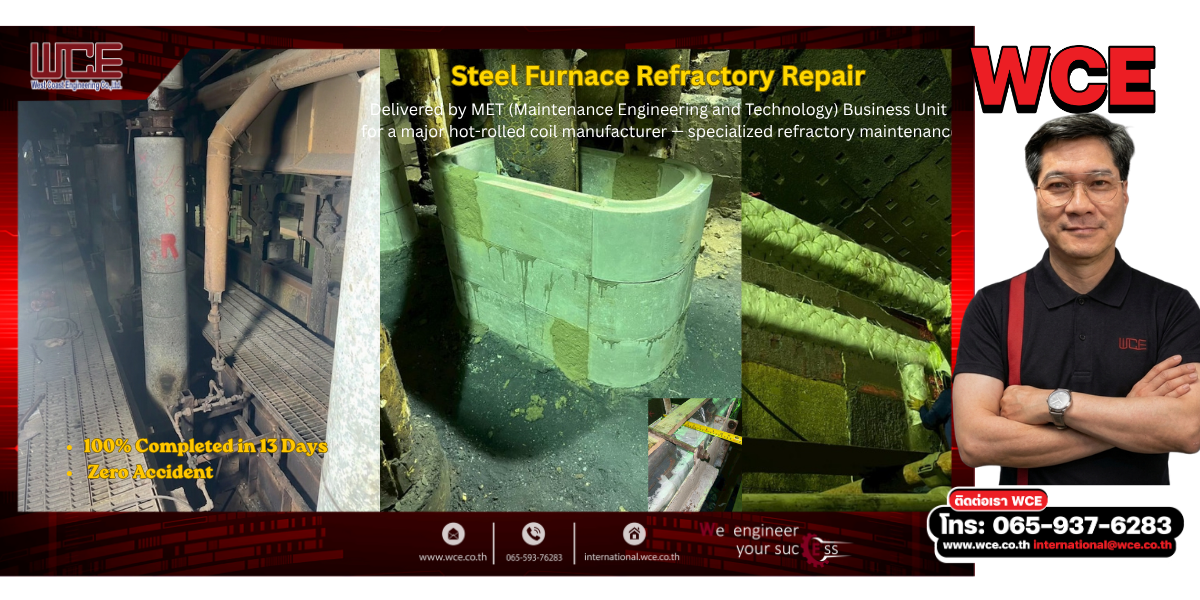
Refractory materials are a critical component of furnaces in the steel industry, serving as thermal insulation and protecting the furnace’s steel shell from temperatures exceeding 1,200°C. The degradation of refractory linings over service life is inevitable, and periodic maintenance is essential to sustain furnace efficiency, product quality, and operational safety. This article examines the fundamentals of refractory materials, degradation mechanisms, repair techniques, applicable international standards, and a real-world project reference demonstrating WCE’s capabilities.
Refractories are inorganic, non-metallic materials capable of withstanding temperatures above 1,000°C without melting, cracking, or deforming. In the steel industry, refractories are used as furnace lining materials to provide thermal insulation—preventing heat loss and protecting the furnace steel shell, chemical resistance against slag and hot gases, abrasion resistance against the movement of raw materials within the furnace; and structural stability under fluctuating temperature and pressure conditions [1].
Refractory materials used in the steel industry are classified by their chemical composition:
Furnace linings in the steel industry typically consist of multiple layers: the working lining (hot face), which is the innermost layer directly exposed to high temperatures and slag, constructed from high-quality refractory bricks; the safety lining, a middle layer acting as a buffer in case the working lining fails; the insulating layer, using insulating bricks or ceramic fiber to minimize heat loss; and the steel shell, the outermost structural envelope of the furnace [5].
Refractory linings in steel furnaces degrade through several mechanisms:
Condition assessment before and after repair is a critical step. Key techniques include visual inspection to identify cracks, spalling, and erosion patterns; shell temperature survey using infrared thermography to locate areas of thinned or damaged refractory; and remaining thickness measurement to quantify the extent of material loss [7].
Refractory repair in steel furnaces employs several methods depending on the nature and extent of the damage:
Refractory repair inside a steel furnace is classified as extremely high-risk work due to the hazardous conditions within the furnace environment.
| Item | Details |
|---|---|
| Project Name | Furnace Refractory Repair |
| Client | A major hot-rolled coil (HRC) manufacturer in Thailand |
| Business Unit | MET — Maintenance Engineering and Technology |
| Scope | Refractory maintenance and repair inside a steel reheating furnace |
| Project Duration | 22 June – 4 July 2026 (13 days) |
| Status | 100% Completed on schedule |
| Safety Record | Zero Accident |
1. Specialized Furnace Refractory Expertise This project required a team with specialized competency in industrial furnace refractory repair. The work involved entering the confined space of the furnace interior, operating under conditions of residual heat, refractory dust exposure, and limited access space. The WCE team maintained strict compliance with safety protocols, including LOTO procedures, confined space entry permits, atmospheric monitoring, and full deployment of specialized PPE throughout the operation.
2. Quality-Assured Repair The team conducted a thorough assessment of the damaged refractory, removed deteriorated sections, and performed repairs using materials meeting applicable ASTM standards. The controlled drying-out (curing) process was carefully managed according to the prescribed heat-up schedule to ensure maximum strength and durability of the new refractory lining.
3. On-Schedule Delivery The project was completed within the planned 13-day duration, aligned with the client’s annual shutdown window. The WCE team coordinated effectively with other concurrent maintenance activities to ensure efficient execution.
[1] Schacht, C.A. (2004). Refractories Handbook. Marcel Dekker, Inc. New York.
[2] ASTM International. (2022). ASTM C27 — Standard Classification of Fireclay and High-Alumina Refractory Brick. West Conshohocken, PA.
[3] ASTM International. (2019). ASTM C455 — Standard Test Method for Determination of Apparent Specific Gravity of Refractory Materials by the Buoyancy Method. West Conshohocken, PA.
[4] ASTM International. (2020). ASTM C401 — Standard Classification of Alumina and Alumina-Silicate Castable Refractories. West Conshohocken, PA.
[5] Harbison-Walker Refractories Company. (2005). Handbook of Refractory Practice. Moon Township, PA.
[6] Lee, W.E. & Zhang, S. (1999). “Melt Corrosion of Oxide and Oxide-Carbon Refractories.” International Materials Reviews, 44(3), 77–104.
[7] Trinks, W., Mawhinney, M.H., Shannon, R.A., Reed, R.J. & Garvey, J.R. (2004). Industrial Furnaces, 6th Edition. John Wiley & Sons, Inc.
[8] The Technical Association of Refractories, Japan. (2010). TARJ Refractory Handbook. Tokyo.
[9] API. (2016). API 560 / ISO 13705 — Fired Heaters for General Refinery Service, 5th Edition. American Petroleum Institute.
[10] NFPA. (2023). NFPA 86 — Standard for Ovens and Furnaces. National Fire Protection Association.
[11] OSHA. (2023). 29 CFR 1910.146 — Permit-Required Confined Spaces. Occupational Safety and Health Administration, U.S. Department of Labor.
[12] OSHA. (2023). 29 CFR 1926.1153 — Respirable Crystalline Silica. Occupational Safety and Health Administration, U.S. Department of Labor.
WCE delivers specialized furnace refractory repair, heavy machinery maintenance, and comprehensive engineering maintenance services across all industry sectors. Our experienced engineering teams and technicians operate to international safety standards, ensuring quality and reliability in every project.
📞 Tel: +66 65-937-6283 📧 Email: international@wce.co.th 🌐 Website: www.wce.co.th
We engineer your success.

