Animal feed plants depend on machinery that runs continuously across the production line. This includes raw material intake, grinding, mixing, pelletizing and conveying up to storage silos. Much of this equipment sits on tall structures. As a result, feed plant machinery maintenance demands more than mechanical expertise. It also requires skill in working at height and rigorous safety management. This article first explains the key principles. It then presents a real project reference from WCE’s MET business unit.
Feed plants operate around the clock. Therefore, unplanned downtime at a single point can stop the whole line. This can quickly lead to losses in cost, delivery schedule and product quality. In contrast, systematic, planned maintenance extends equipment life and reduces the risk of emergency failure. It also keeps production efficiency stable.
Preventive maintenance follows a time or runtime schedule. Typical tasks include lubrication, wear-part replacement, alignment checks and retorquing of fasteners. In other words, it fixes issues before they occur. For this reason, it is the most effective way to reduce emergency breakdowns.
Predictive maintenance uses condition-monitoring data, such as vibration analysis, temperature and acoustic signatures. With this data, teams can forecast degradation trends. They can then plan repairs before parts actually fail. As a result, they can choose the most cost-effective shutdown timing.
Corrective maintenance takes place when machinery has failed or runs abnormally. The crew replaces bearings, gear sets or worn parts to restore the machine to service. However, this work only succeeds when the crew can find root causes accurately and act quickly to minimize downtime.
Several types of equipment need regular maintenance. First, bucket elevators and belt or screw conveyors often sit at height. Next, hammer mills and pellet mills wear quickly under heavy load. Finally, gear motors and bearings form the heart of power transmission. At all these points, teams should monitor lubrication, vibration and alignment consistently.
Much of a feed plant’s conveying machinery sits several meters up on structural platforms. Removing, hoisting and reassembling heavy parts, such as gear sets or motors, therefore requires chain hoists and safe load-bearing anchor points. In addition, careful work sequencing helps the crew work securely in confined, elevated spaces.
Work at height is a high-risk activity with strict standards. Key controls include fall protection, such as full-body harnesses and certified anchor points. Next comes Lockout/Tagout (LOTO), which isolates energy before anyone works on machinery. In addition, crews inspect lifting equipment before use, and a dedicated safety supervisor stays on station. These practices align with international standards such as OSHA 1926.501 and ANSI/ASSE Z359. Ultimately, sound safety planning and specially trained crews make it possible to finish this work without incident.
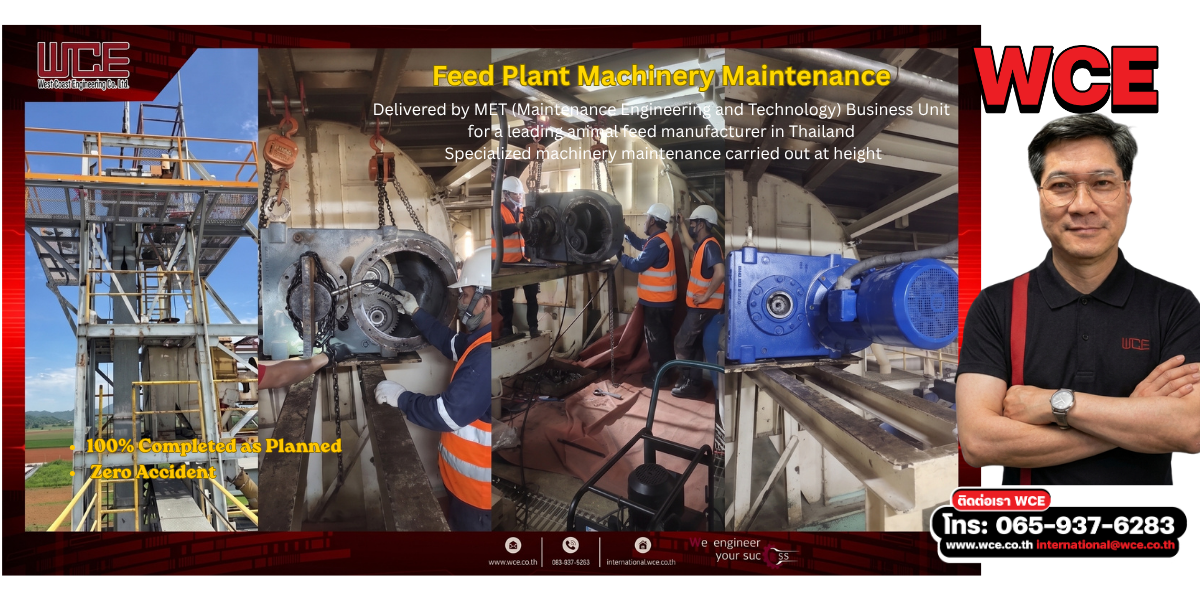
WCE’s MET (Maintenance Engineering and Technology) business unit maintained machinery for a leading animal feed manufacturer. The work required specialized expertise in machinery maintenance at height.
First, the team diagnosed the machinery. Next, it removed and hoisted the units for service, then repaired and reassembled them. Throughout the project, the team kept work-at-height safety controls in place. It completed all work within the scheduled window, from 1 to 31 July 2026.
This project shows WCE’s readiness to deliver industrial machinery maintenance. Moreover, it combines mechanical expertise with rigorous work-at-height safety management.
WCE provides end-to-end industrial machinery maintenance, work-at-height services and plant maintenance engineering. Our experienced engineers and technicians support you from on-site assessment through handover and after-service support.
📞 Tel: +66 65-937-6283 | 📧 Email: international@wce.co.th | 🌐 Website: www.wce.co.th
We engineer your success.