A guide assembly in a steel production line guides and supports moving parts or material. Over time, its parts wear and rust, and its hydraulic lines degrade. This article explains the principles of a guide assembly overhaul. It covers inspection, part repair, hydraulic reassembly, and protective painting. Finally, it presents a case study: a complete guide assembly overhaul by WCE’s MTE business unit.
EN 13306 sets a common vocabulary for maintenance. It covers technical, administrative, and managerial work, including maintenance types and activities [1]. In an overhaul, the team dismantles the whole assembly, then inspects and repairs it in detail. Finally, it reassembles the unit ready for service. This differs from a spot repair, which fixes only the damaged part.
Surfaces that slide against each other suffer sliding and adhesive wear. In these processes, material is damaged and removed during contact [2]. Therefore, dismantling the whole assembly lets the team see wear on every part and plan the repair precisely.
One filtration manufacturer states that contamination causes over 70% of hydraulic system failures. Solid particles speed up wear and can cause seizure, leakage, and loss of control. In addition, contaminants can enter during assembly and maintenance [3]. For this reason, cleaning pipes and fittings before reassembly is a key step.
The ISO 12944 series covers corrosion protection of steel structures with protective paint systems [4]. As a result, proper surface preparation and repainting after repair help prevent rust and extend the life of the assembly.
After the parts are repaired, the team reassembles the guide to the correct positions and alignment. Next, it refits the hydraulic lines. Finally, it checks the complete unit before delivery, so the client can install it right away.
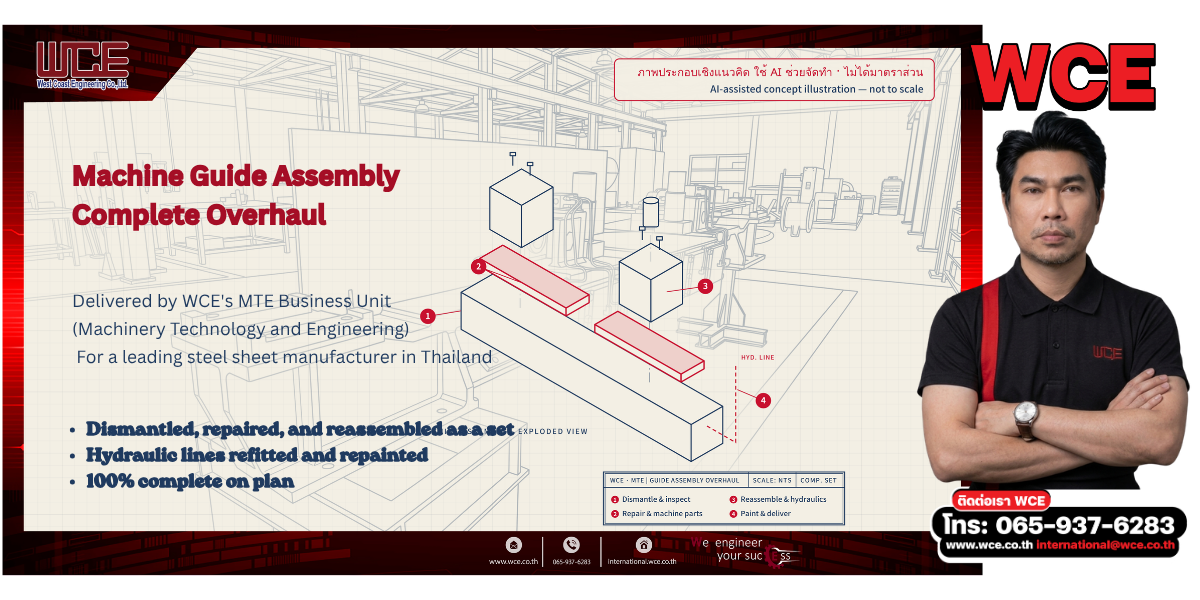
Before repair, the guide assembly was worn and rusted. First, the MTE team dismantled and inspected the parts. Next, it repaired and machined the damaged parts. Then the team reassembled the unit and refitted the hydraulic lines. Finally, it repainted the assembly before delivery. As a result, the work was finished on plan.
The cover image is a concept illustration. In the background, a perspective line drawing shows the finished guide assembly in the repair shop. On the right, an exploded view shows the guide assembly. Red highlights mark the liners and the hydraulic line. The four work steps complete the drawing. All images were created with AI assistance, so no person or client can be identified.
A guide assembly overhaul restores worn equipment to service without buying a new unit. In addition, this type of work combines machining, assembly, and hydraulics. For this reason, one team handled every step from start to finish.
WCE’s MTE (Machinery Technology and Engineering) business unit manufactures, repairs, and overhauls large machinery parts and assemblies.
Contact: +66 65-937-6283 | international@wce.co.th | www.wce.co.th
We engineer your success.

