Industrial exhaust fans run around the clock. When a bearing fails, the fan must stop at once, and production may suffer. This article explains why bearings fail, how a new fan is fitted, and why vibration testing after installation matters. Finally, it presents a breakdown repair and exhaust fan replacement case study by WCE’s MTE business unit.
According to one major bearing maker’s experience, about one third of bearings that fail in service do so from fatigue. Another third fail from lubrication problems. About one sixth fail from contamination, and the rest from other causes such as poor handling and mounting [2]. In addition, mounting force on the wrong ring or hammer blows can deform or crack the raceways [2].
Breakdown maintenance means repairing equipment after it has failed. The goal is to restore service as fast as possible. Therefore, the team must diagnose the fault, remove the damaged parts, and have new parts ready right away.
A new fan may have a flange size or bolt pattern that does not match the existing duct and base. For this reason, modifying the flange lets the new fan fit the existing system without changing the whole duct. In addition, modified parts should meet the specified tolerances [3].
ISO 20816-3 gives guidance for evaluating vibration of industrial machines above 15 kW, including fans and blowers. It applies to both acceptance testing and operational monitoring [1]. As a result, measuring vibration after installation confirms that the fan is well aligned and balanced before it returns to service.
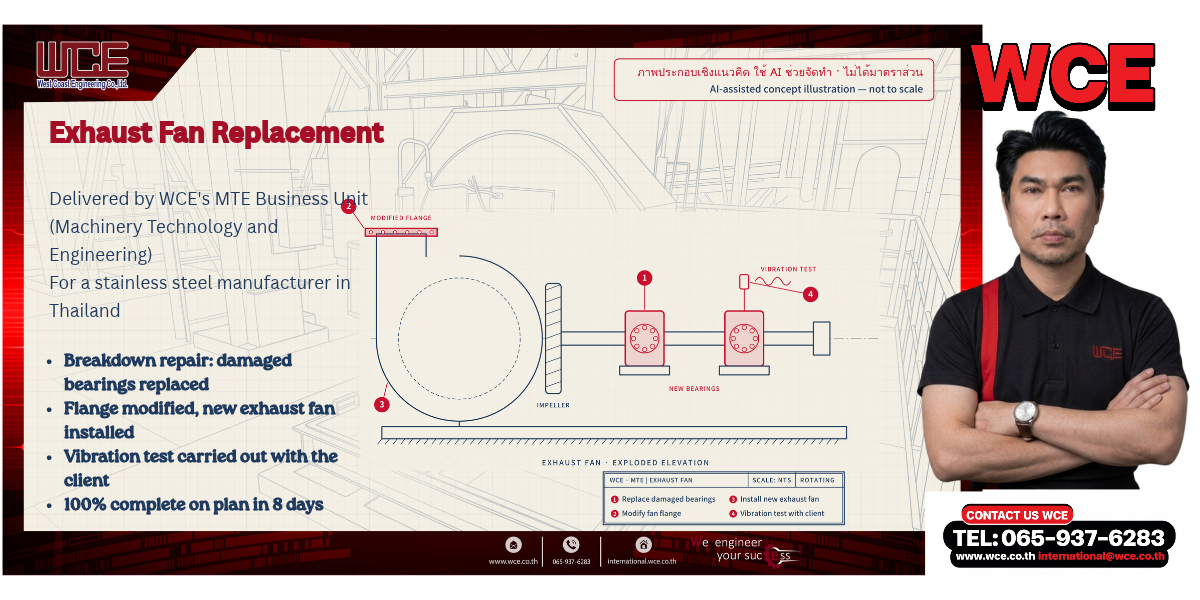
First, the MTE team removed and replaced the damaged bearings. Next, it modified the flange of the new fan. Then the team installed the new exhaust fan. Finally, it carried out a vibration test together with the client after installation. As a result, the work was finished on plan in 8 days.
The cover image is a concept illustration. In the background, a perspective line drawing shows the fan and its base in the plant. On the right, an exploded side view shows the fan, with the new bearings, the modified flange, and a vibration sensor highlighted in red. The four work steps complete the drawing. All images were created with AI assistance, so no person or client can be identified.
Breakdown repair needs both speed and care. In addition, adapting parts to the existing system and testing with the client before handover gave confidence in the result. For this reason, the exhaust fan returned to service within a short time.
WCE’s MTE (Machinery Technology and Engineering) business unit manufactures, repairs and installs industrial machinery and rotating equipment, including breakdown repairs.
Contact: +66 65-937-6283 | international@wce.co.th | www.wce.co.th
We engineer your success.

