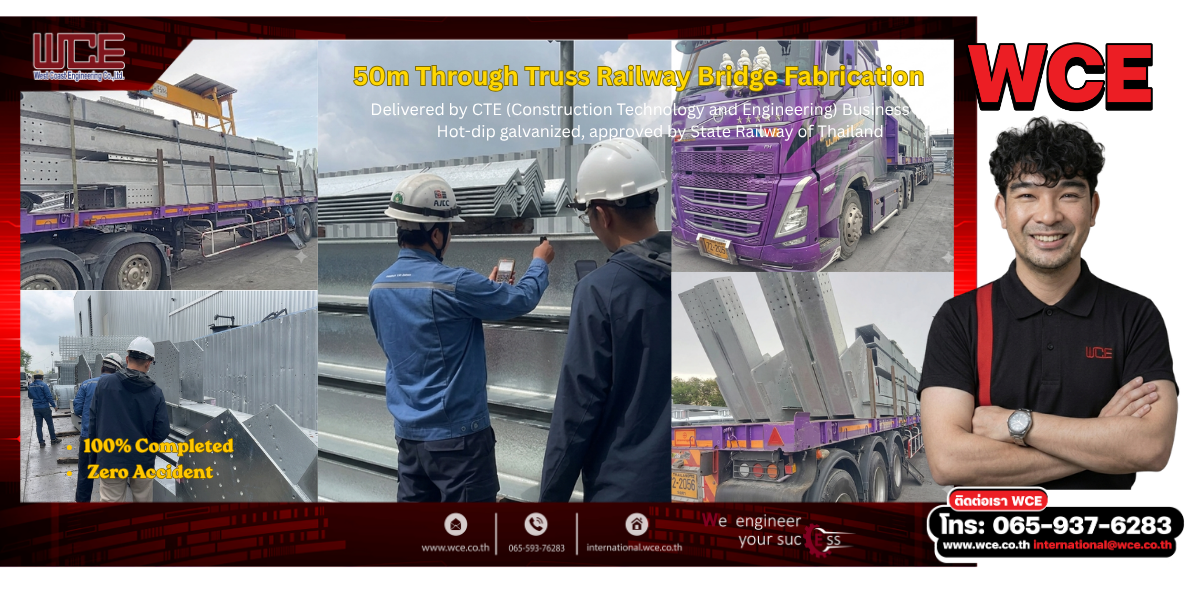
Steel bridges are critical infrastructure in railway systems, carrying train loads across rivers, roads, and varied terrain. The through truss bridge is one of the most widely used configurations in Thailand’s railway network, offering high load capacity, long spans, and favorable inspection and maintenance characteristics. This article examines the structural engineering principles of steel railway bridges; the fabrication process, including trial assembly; hot-dip galvanizing for corrosion protection; quality control requirements; and a real-world project reference demonstrating WCE’s capabilities.
A through truss bridge features truss assemblies on both sides of the railway track, with the deck positioned at the bottom chord level. Trains pass through the center of the structure, between the two truss planes. This configuration offers several advantages: it enables long spans of 50 meters or more without intermediate supports in the waterway; distributes loads efficiently through truss members—each primarily in either tension or compression; the height of the truss increases the moment of inertia for greater stiffness; and all structural members are accessible for inspection and maintenance [1].
Steel railway bridge design in Thailand references several key standards:
Railway bridges must accommodate multiple load types: dead load (self-weight of the bridge structure), live load (weight of passing trains), impact load (vibration and wheel impact forces), lateral force (wind loads and centrifugal forces from train movement), and fatigue load (repeated cyclic loading over the bridge’s service life) [3].
Steel bridge fabrication requires precision manufacturing and rigorous quality control:
Trial assembly before galvanizing is a critical quality assurance step. It confirms that all components fit correctly, bolt holes align, and the bridge geometry matches engineering drawings. It also allows detection and correction of issues before galvanizing—post-galvanizing corrections are difficult and costly. Additionally, it serves as a quality hold point for project owners and inspectors [7].
Hot-dip galvanizing coats steel with zinc by immersing the fabricated components in a molten zinc bath at approximately 450°C. The zinc reacts metallurgically with the steel to form iron-zinc alloy layers that bond permanently to the steel surface, providing long-lasting corrosion protection [8].
Hot-dip galvanizing is particularly well-suited for railway bridges: it provides a service life of 50 years or more in typical environments, protects both external and internal surfaces of hollow sections and channels, offers superior abrasion resistance compared to paint systems, reduces long-term maintenance costs by eliminating the need for frequent repainting, and is environmentally sustainable as zinc is fully recyclable [8].
Steel railway bridges undergo rigorous multi-party quality inspections:
| Item | Details |
|---|---|
| Project Name | Fabrication of 50-Meter Through Truss Steel Railway Bridge |
| Client | An infrastructure contractor |
| Business Unit | CTE — Construction Technology and Engineering |
| Scope | Steel bridge fabrication → Trial assembly → Hot-dip galvanizing → Quality inspection → Transportation and delivery to site |
| Installation Location | Southern Thailand railway line, Narathiwat Province |
| Project Duration | April 2025 – June 2026 (approximately 14 months) |
| Status | 100% Completed on schedule |
| Safety Record | Zero Accident |
1. Trial Assembly Before Galvanizing WCE performed a full trial assembly of the complete bridge structure in the factory before sending components for hot-dip galvanizing. This critical step confirmed that all dimensions, positions, and the overall bridge geometry precisely matched the engineering drawings, minimizing the risk of post-galvanizing issues.
2. Quality Approved by State Railway of Thailand The galvanized bridge components passed rigorous quality inspection by State Railway of Thailand officials before delivery authorization was granted.
3. Complete End-to-End Service: WCE delivered the full scope from factory fabrication, trial assembly, galvanizing coordination, and quality inspection through to transportation and delivery of the bridge to the project site for the client’s on-site assembly and installation.
[1] Xanthakos, P.P. (1994). Theory and Design of Bridges. John Wiley & Sons.
[2] State Railway of Thailand. Railway Bridge Design Standards. Bangkok.
[3] AREMA. (2020). Manual for Railway Engineering, Chapter 15: Steel Structures. American Railway Engineering and Maintenance-of-Way Association.
[4] AISC. (2022). Steel Construction Manual, 16th Edition. American Institute of Steel Construction.
[5] AWS. (2015). AWS D1.5/D1.5M — Bridge Welding Code. American Welding Society.
[6] ASNT. (2016). Nondestructive Testing Handbook, 4th Edition. American Society for Nondestructive Testing.
[7] Salmon, C.G., Johnson, J.E. & Malhas, F.A. (2009). Steel Structures: Design and Behavior, 5th Edition. Pearson Education.
[8] American Galvanizers Association. (2023). Hot-Dip Galvanizing for Corrosion Protection: A Specifier’s Guide. Centennial, CO.
[9] ASTM International. (2017). ASTM A123/A123M — Standard Specification for Zinc (Hot-Dip Galvanized) Coatings on Iron and Steel Products. West Conshohocken, PA.
[10] ISO. (2009). ISO 1461 — Hot Dip Galvanized Coatings on Fabricated Iron and Steel Articles — Specifications and Test Methods. International Organization for Standardization.
[11] ASTM International. (2022). ASTM A370 — Standard Test Methods and Definitions for Mechanical Testing of Steel Products. West Conshohocken, PA.
WCE delivers steel bridge fabrication, railway infrastructure structures, and all types of structural steel construction. Our certified fabrication facility, experienced engineering teams, and rigorous quality management system ensure the highest standards in every project.
📞 Tel: +66 65-937-6283 📧 Email: international@wce.co.th 🌐 Website: www.wce.co.th
We engineer your success.

