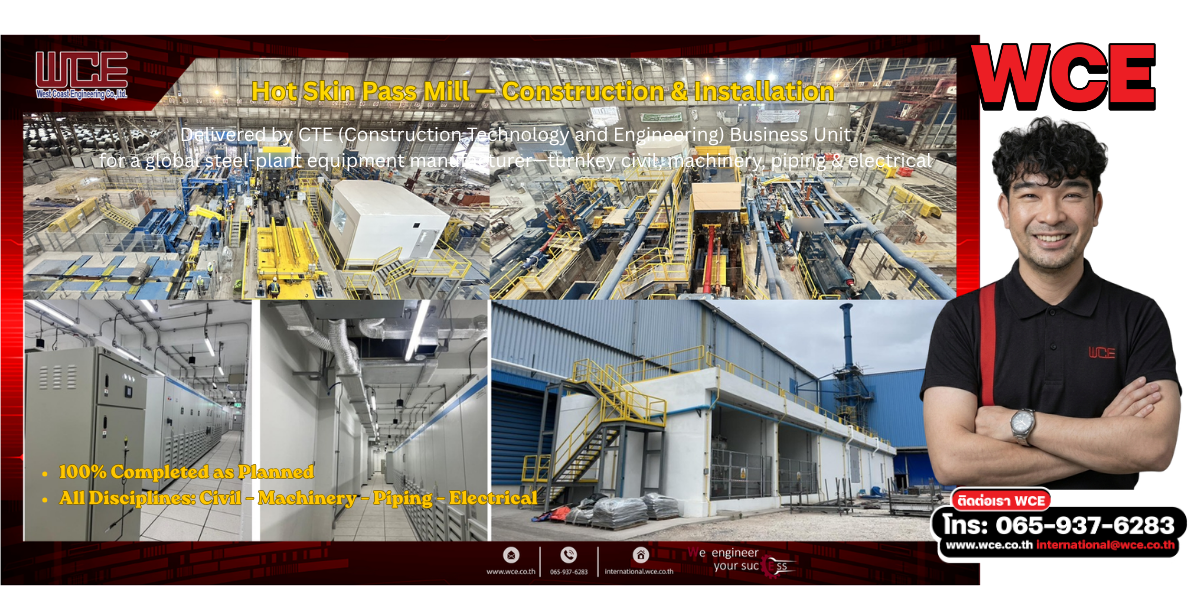
Building a large steel production line, such as a skin pass mill, brings several disciplines together at once. A skin pass mill is a temper or surface-conditioning mill for steel strip. Its installation covers foundations and civil works, heavy machinery erection, and piping and electrical systems. Every part must be precise. In addition, every team must coordinate closely so the line can run at full performance. This article first explains the engineering behind this type of project. It then presents a real project reference from WCE’s CTE business unit.
A skin pass mill, also called a temper mill, rolls steel strip under a very light reduction. It works in the final stage of processing. Its job is to improve flatness, surface finish, and mechanical properties. It also removes certain surface defects before the steel moves on. Because these mills are central to producing high-quality flat steel, they need a stable foundation and high-precision alignment.
Installing a steel production line is not a single job. Instead, it combines several disciplines that must move forward together: civil and foundation works, mechanical erection, piping, and electrical and instrumentation (E&I). As a result, project success depends on planning and coordinating all disciplines throughout construction.
Steel-line machinery is very heavy. It also generates high vibration in operation. Therefore, engineers must design and build the foundation to carry the load and control settlement. The foundation must also hold the anchor bolts that secure the equipment in precise positions. In addition, concrete works across all areas must match the drawings for level, flatness, and anchor positions. Even a small foundation deviation directly affects machine alignment and service life.
Once the foundation is ready, the erection team lifts, positions, and assembles large components. Next, the team aligns and levels each machine to the manufacturer’s specifications. This stage requires suitable lifting equipment, tight work sequencing, and high precision. As a result, the machines can run smoothly together across the whole line.
A production line needs complete supporting systems. Piping carries fluids such as cooling water, hydraulic oil, and compressed air. Meanwhile, electrical and instrumentation systems provide power and control. The team must route pipes, install switchgear, lay cables, and set up control systems neatly and safely. Together, these systems connect every machine into a single, ready-to-run line.
After installation, the project enters commissioning. During this stage, the team tests and adjusts the whole system so it works together before actual production, such as the 1st coil production. Commissioning proves the integrity of all construction and installation work. For this reason, it requires close coordination between the installer and the machine technology owner.
WCE’s CTE (Construction Technology and Engineering) business unit built and installed a Hot Skin Pass Mill for a global steel-plant equipment manufacturer. The scope covered both civil construction and erection work. This included concrete works across all areas, machinery installation, and piping and electrical systems.
The team delivered every discipline systematically within the project window, from July 2025 through mid-2026. Today, the client has received the line, and it has entered commissioning to prepare for 1st coil production.
This large-scale project shows WCE’s readiness to take on complete industrial plant construction and installation. It combines multiple disciplines and keeps a major project on plan.
WCE provides complete industrial plant construction and installation, including civil works, machinery erection, and piping and electrical systems. Our experienced engineers and technicians support you from on-site assessment through handover and after-service support.
📞 Tel: +66 65-937-6283 | 📧 Email: international@wce.co.th | 🌐 Website: www.wce.co.th
We engineer your success.