Summary
A Continuous Emission Monitoring System (CEMS) measures air pollutants from industrial stacks continuously, allowing plants to track their emissions at all times. This article explains how CEMS works and presents a CEMS installation project delivered by WCE’s RAT business unit.
1. What is CEMS?
CEMS continuously measures gases and particulates leaving a stack. Commonly monitored parameters include NOx, SO₂, CO, CO₂, O₂, opacity, particulate matter, and flow rate [1]. Under US Performance Specification 2, a CEMS consists of four major subsystems: the sample interface, the pollutant analyzer, the diluent analyzer (e.g., O₂), and the data recorder [2].
In Thailand, a Ministry of Industry notification issued in 2022 requires certain listed factory types to install stack emission monitoring instruments and report data to the Department of Industrial Works [4][5], making CEMS an essential system for large industrial plants.
2. Key Principles
2.1 Extractive systems
A sample is drawn from the stack through a probe and a heated sample line to prevent condensation, then conditioned (filtered and dried) before reaching analyzers housed in a cabinet or shelter. Keeping analyzers away from the hot, corrosive stack environment makes maintenance and calibration easier [1]. ISO 10396 provides guidance on sampling for permanently installed automated gas monitoring systems [3].
2.2 In-situ systems
Sensors are mounted directly on the stack, either measuring at a single point or across the stack (path). No sample transport is needed, but maintenance is harder because the equipment sits on the stack [1].
2.3 Data quality
CEMS data must pass relative accuracy testing against reference methods during normal operation, along with routine zero and span checks [2]. A data acquisition system (DAS) records, calculates, and reports results continuously.
3. Case Study: CEMS Installation by the RAT Business Unit
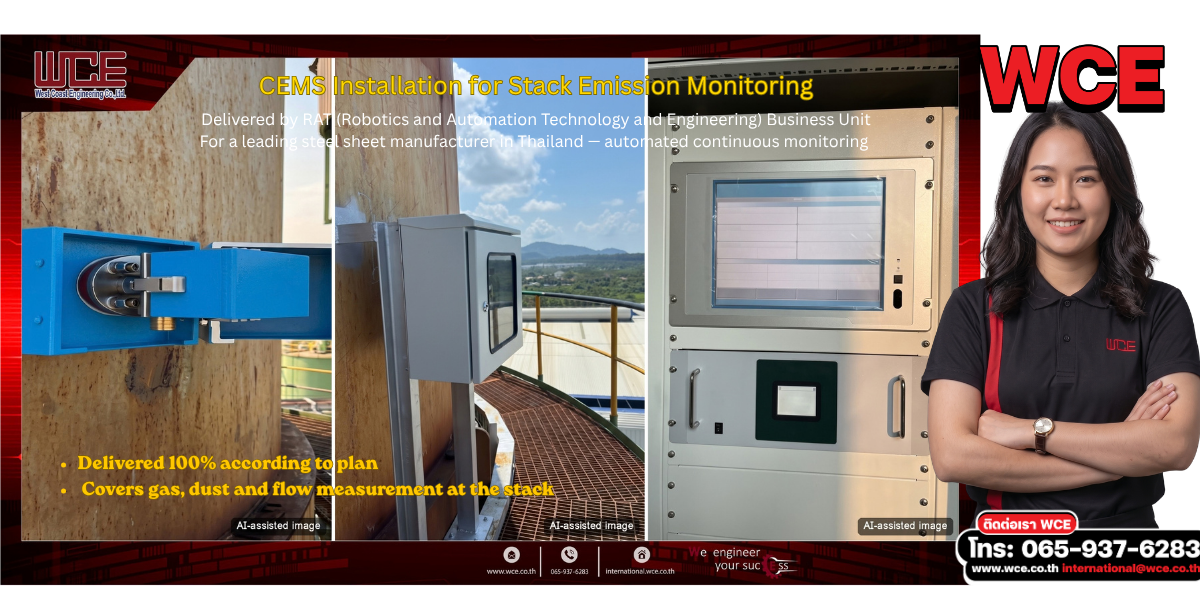
Scope: Installation of an automated stack emission monitoring system (CEMS), covering field equipment on the stack and the gas analyzer cabinet. The system measures NOx, CO, O₂ and SO₂, together with physical stack gas parameters: flow, temperature, pressure, opacity, and dust.
Client: A leading steel sheet manufacturer in Thailand
Duration: 6 June 2025 – 31 May 2026 (approx. 12 months)
Progress: 100% complete, according to plan
The cover image shows, from left to right, equipment mounted on the stack wall, an equipment enclosure on the stack platform, and the gas analyzer cabinet with its display. All images have been AI-assisted to prevent identification of individuals or the client.
4. Considerations for CEMS Installation
– The measurement location on the stack affects data accuracy and should be considered from the planning stage
– Stack installation is work at height and must be planned around safety and the plant’s operating schedule.
– After installation, the system requires regular calibration and maintenance to keep data reliable throughout its service life.
5. WCE Services
WCE’s RAT business unit provides automation, instrumentation, and control system services for industrial plants.
Contact: +66 65-937-6283 | international@wce.co.th | www.wce.co.th
We engineer your success.
References
[1] Mussatti, D.C., et al. (2002). EPA Air Pollution Control Cost Manual, Section 2, Chapter 4: Monitors (EPA/452/B-02-001). U.S. Environmental Protection Agency. https://19january2021snapshot.epa.gov/sites/static/files/2020-11/documents/cs2ch4.pdf
[2] U.S. EPA. 40 CFR Part 60, Appendix B – Performance Specifications (PS-2: SO₂ and NOx CEMS). https://www.law.cornell.edu/cfr/text/40/appendix-B_to_part_60
[3] ISO 10396:2007 Stationary source emissions—Sampling for the automated determination of gas emission concentrations for permanently installed monitoring systems. https://scc-ccn.ca/standardsdb/standards/8119700
[4] Department of Industrial Works. (2024). Public hearing summary: Draft Ministry of Industry Notification on special instruments for reporting air pollution from factory stacks (No. …). (In Thai) https://www.diw.go.th/webdiw/wp-content/uploads/2024/02/r29022567-01.pdf
[5] Office of Natural Resources and Environmental Policy and Planning. (2022). Over 600 factories are required to install CEMS. (In Thai) https://www.onep.go.th/?p=66679
(Accessed 7 October 2026)

