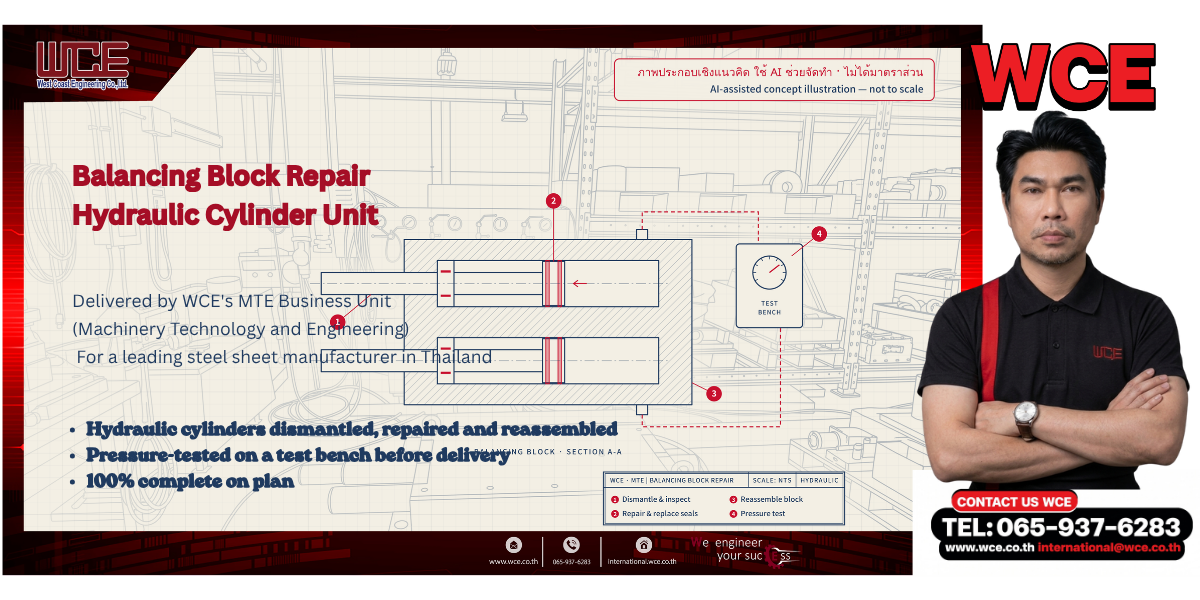
A balancing block is a unit with hydraulic cylinders built inside. It provides support or counterbalance force for parts of a machine in a steel production line. Over time, the cylinders may leak or behave abnormally. This article explains how a hydraulic cylinder works, why it leaks, and why testing after repair matters. Finally, it presents a case study: a hydraulic cylinder repair on a balancing block by WCE’s MTE business unit.
A hydraulic cylinder turns oil pressure into mechanical force. Inside the barrel, a piston connects to a rod. When high-pressure oil enters, the piston pushes the rod out. Meanwhile, seals on the piston and at the rod end stop oil from leaking past. As a result, the cylinder holds its force and position steadily.
Common causes of leakage and drift include failed piston seals that let oil bypass internally. In addition, worn rod seals often cause visible external leaks. Contaminated fluid also wears seals faster [2]. Therefore, dismantling the whole unit helps the team find the real cause.
One filtration manufacturer states that contamination causes over 70% of hydraulic system failures. Contaminants can also enter during assembly and maintenance [3]. For this reason, cleaning every part before reassembly is a key step in any repair.
ISO 10100 specifies acceptance and function tests for hydraulic cylinders [1]. In practice, testing on a bench with pressure gauges helps reveal both external and internal leaks. As a result, the unit goes back into service only after it proves sound [2].
First, MTE’s hydraulic service team dismantled and inspected the balancing block. Next, it repaired the hydraulic cylinder parts and reassembled the unit. Finally, the team pressure-tested the block on a test bench before delivery. As a result, the work finished on plan.
The cover image is a concept illustration. In the background, a perspective line drawing shows a hydraulic test bench in the repair shop. On the right, a section view shows the balancing block with two hydraulic cylinders. Red highlights mark the seal positions, and a line runs to the test bench. The four work steps complete the drawing. All images were created with AI assistance, so no person or client can be identified.
Hydraulic equipment that works under high pressure must pass a test before reuse. In addition, an in-house test bench lets the team verify its work right away. For this reason, the client receives a unit that is ready to install.
WCE’s MTE (Machinery Technology and Engineering) business unit manufactures, repairs, and overhauls large machinery parts, including hydraulic equipment.
Contact: +66 65-937-6283 | international@wce.co.th | www.wce.co.th
We engineer your success.

