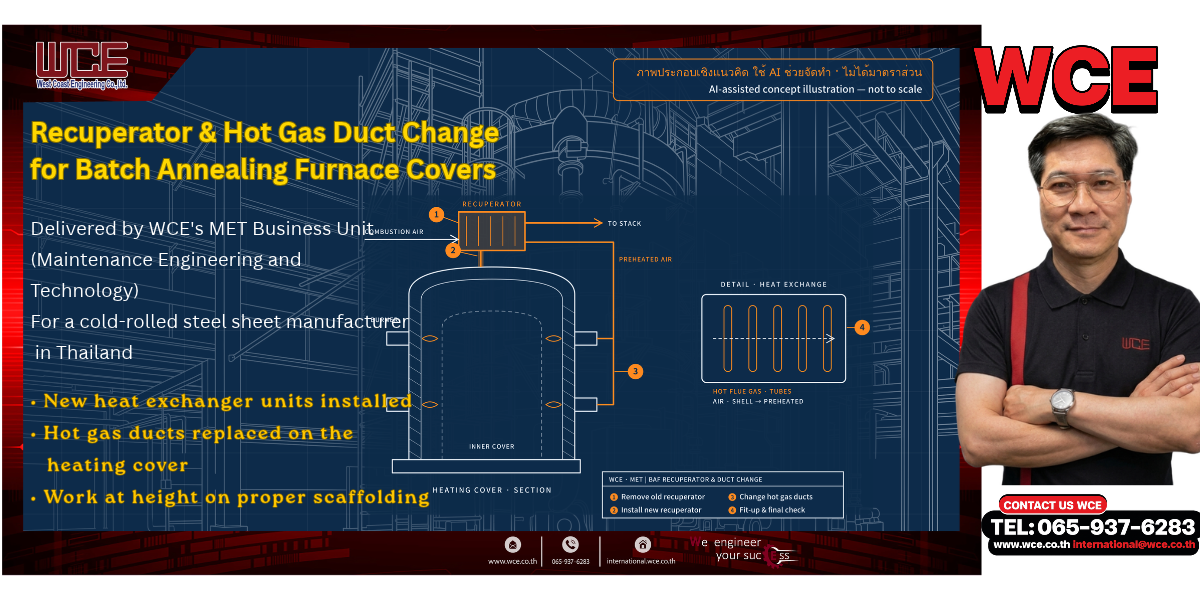
Bell-type annealing furnaces in cold rolling mills use burners to heat steel coils. The exhaust that leaves the furnace is still very hot. For this reason, many furnaces use a recuperator to recover that heat and preheat the combustion air. This article explains how a recuperator works, how it affects fuel use, and the key points of replacing it and its hot gas ducts. Finally, it presents a batch annealing furnace recuperator change by WCE’s MET business unit.
In batch annealing, coils are stacked on an annealing base. First, a sealed inner cover is placed over them. Next, a heating cover with burners fits over the inner cover. The burners heat the outside of the inner cover, which then radiates heat to the coils [1]. Meanwhile, hot exhaust gas leaves the heating cover through hot gas ducts to the stack.
A recuperator is a gas-to-gas heat exchanger. Its tubes or plates move heat from the outgoing exhaust into the incoming combustion air without mixing the two streams. As a result, the furnace needs less fuel because it reuses heat that would otherwise leave through the stack [2].
The US Department of Energy states that waste heat recovery often cuts energy use by 5% to 30% [3]. For example, with exhaust at 1,600°F (about 870°C) and air preheated to 800°F (about 430°C), fuel savings reach about 22% [2]. However, actual results depend on the exhaust temperature and how far the air is preheated.
Dirty or corrosive exhaust gas can plug or attack heat exchangers [2]. When a recuperator or its ducts degrade, heat transfer drops, and leaks may appear. Therefore, replacing the equipment restores furnace efficiency.
The recuperator and hot gas ducts sit on top of the heating cover. For this reason, removal and installation take place on scaffolding. In addition, ducts and flanges must be aligned and sealed, so hot gas does not leak when the furnace restarts.
This project drew on the MET team’s skill in heat exchanger installation. First, the team removed the old recuperator. Next, it installed the new unit. Then it replaced the hot gas ducts on the heating cover. Finally, the team fitted up and checked the work. All of this took place on scaffolding around the furnace.
The cover image is a concept illustration. In the background, a perspective line drawing shows the heating cover and scaffolding in the plant. On the right, a section view shows the burners, inner cover, and recuperator, with the paths of exhaust gas and preheated air. Orange highlights mark the recuperator and ducts, and a detail view explains heat exchange. All images were created with AI assistance, so no person or client can be identified.
A recuperator plays a key role in a furnace’s energy use. Therefore, replacing worn units and ducts in time helps keep the furnace efficient. In addition, this work needs both heat exchanger skills and safe work at height.
WCE’s MET (Maintenance Engineering and Technology) business unit maintains machinery and equipment in industrial plants, including heat exchanger and piping installation.
Contact: +66 65-937-6283 | international@wce.co.th | www.wce.co.th
We engineer your success.

