Steel strip lines wind and unwind coils around a mandrel. For this reason, the mandrel is a large shaft that must be accurate and strong. This article explains the mandrel’s role in a coil line. It also covers key principles of machining large shafts. Finally, it presents a case study: mandrel machining for a coil transfer arm by WCE’s MTE business unit.
At a coiler, steel strip wraps around a rotating mandrel to form a coil. This type of mandrel is collapsible. After coiling, a coil car supports the finished coil and moves it away [1]. Meanwhile, at an uncoiler, conical mandrels enter the eye of the coil. They grip the coil and feed strip into the line [2].
The mandrel surface touches the inner wraps of the coil directly. One uncoiler patent notes that older ribbed mandrels could dent the inner wraps. In addition, worn ribs could lead to strip breaks [2]. Therefore, the mandrel’s shape and surface must match the drawing closely.
ISO 2768 sets general tolerances. Part 1 covers linear and angular dimensions. Part 2 covers geometrical tolerances such as straightness, circularity, coaxiality, and circular run-out for machined features [3]. For a rotating, load-bearing shaft, these values directly affect machine performance.
Machinists often turn long shafts between centres and support the middle with a steady rest. However, even a slight bow can cause run-out at the shaft ends. As a result, correct setup helps the ends turn concentrically [4].
After the main turning, a boring mill often machines features such as keyways, flats, or mounting holes. This machine can handle large workpieces. In addition, a clear sequence between machines helps keep the part accurate throughout the process.
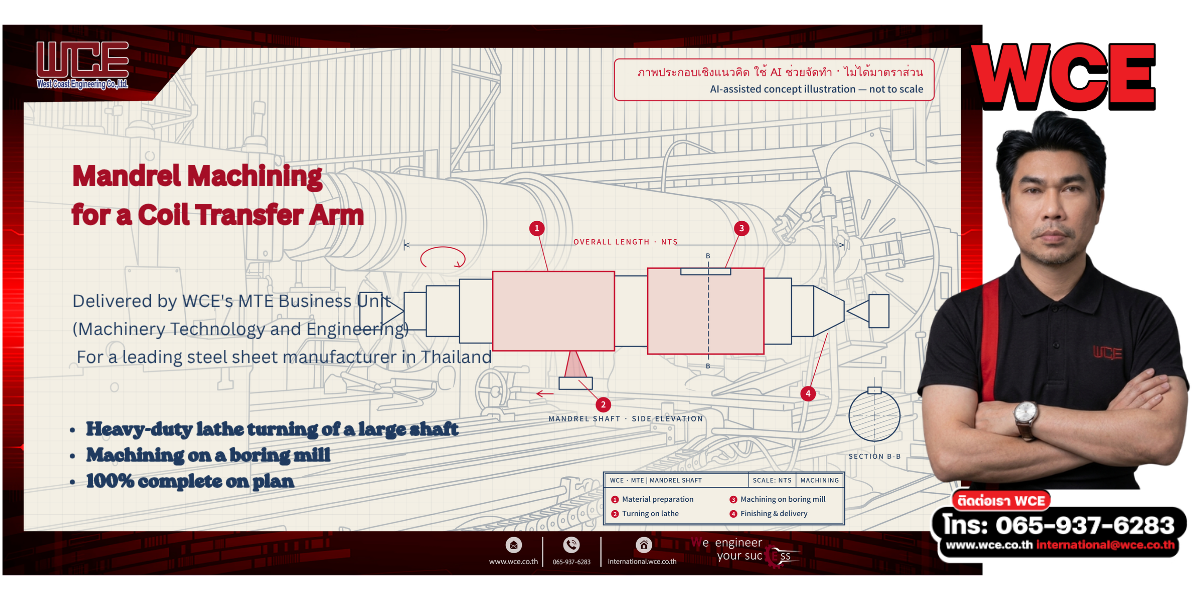
First, the MTE team prepared the material. Next, it turned the shaft on a heavy-duty lathe. Then the team machined further features on a boring mill. Finally, it finished and delivered the part. As a result, the work was finished on plan in 55 days. This project reflects MTE’s core skill in large shaft machining for machinery parts.
The cover image is a concept illustration. In the background, a perspective line drawing shows a lathe holding a large shaft. On the right, a side elevation shows the mandrel between centres, with a Section B-B view. Red highlights mark the machined zones. The four work steps complete the drawing. All images were created with AI assistance, so no person or client can be identified.
A mandrel works continuously in a coil line. For this reason, large shaft machining needs both capable machines and a clear sequence between the lathe and the boring mill. In addition, careful planning keeps the part on drawing and on schedule.
WCE’s MTE (Machinery Technology and Engineering) business unit manufactures, repairs, and machines large machinery parts with heavy-duty machine tools.
Contact: +66 65-937-6283 | international@wce.co.th | www.wce.co.th
We engineer your success.

