Main power cables carry electrical energy to a passenger coach’s key systems. These include air conditioning, lighting, and controls. After an accident, the wiring may suffer hidden damage. For this reason, main power cable replacement and insulation testing are key steps before a coach returns to service. This article explains the principles behind this work. It then presents a case study from WCE’s Rail Technology and Engineering Business Unit (RTE).
Passenger coaches need electricity for onboard systems such as air conditioning, lighting, and control equipment. In many systems, a main source in the train supplies this power. Main cables then carry it along the full length of the train. Inside each coach, the cables run along the car body. Between coaches, jumpers, and receptacles link them together.
For example, the American Public Transportation Association (APTA) publishes a recommended practice for 480 Vac Head End Power systems. It specifies several jumpers in parallel at each car-to-car connection. It also covers cabling, power distribution, and testing [3].
These cables carry power for several coaches in sequence. As a result, damage at a single point can affect the power supply to the whole train.
Railway cables face conditions that building cables do not. These include constant vibration, wide temperature changes, and strict fire-safety rules. The European standard EN 50264 covers power and control cables with special fire performance for rolling stock. It sets requirements for insulating and sheathing materials [2]. For instance, its part on single-core cables specifies halogen-free crosslinked elastomeric insulation. It also sets a continuous conductor temperature of 90°C [5].
Good cables alone do not guarantee a reliable system. Installation quality matters just as much. EN 50343 sets requirements for cabling on railway vehicles. It covers cables, busbars, terminals, and plug-and-socket devices [1]. In addition, APTA recommends insulated cable cleats at least every 1.22 m (4 ft) to support power cables [3]. Proper support reduces chafing and vibration damage in service.
An insulation resistance test applies a DC voltage to the conductor. The tester then measures the small leakage current through and across the insulation. It shows the result as resistance in megohms. This method does not damage the cable [4]. Technicians commonly use two approaches:
The same guide offers a rule of thumb: about one megohm per 1,000 volts of operating voltage. It also advises matching the test voltage to the equipment rating [4]. However, each project’s actual acceptance criteria depend on the applicable standards and the system owner’s requirements. APTA also lists continuity, insulation resistance, and dielectric tests as part of HEP system testing [3].
Many factors can weaken insulation. These include mechanical damage, vibration, heat, cold, moisture, and contamination. Even tiny cracks or pinholes can create leakage paths [4]. In an accident, impact, crushing, or heat may damage the cables. Therefore, a new cable set plus insulation testing helps confirm the system’s condition before the coach returns to service.
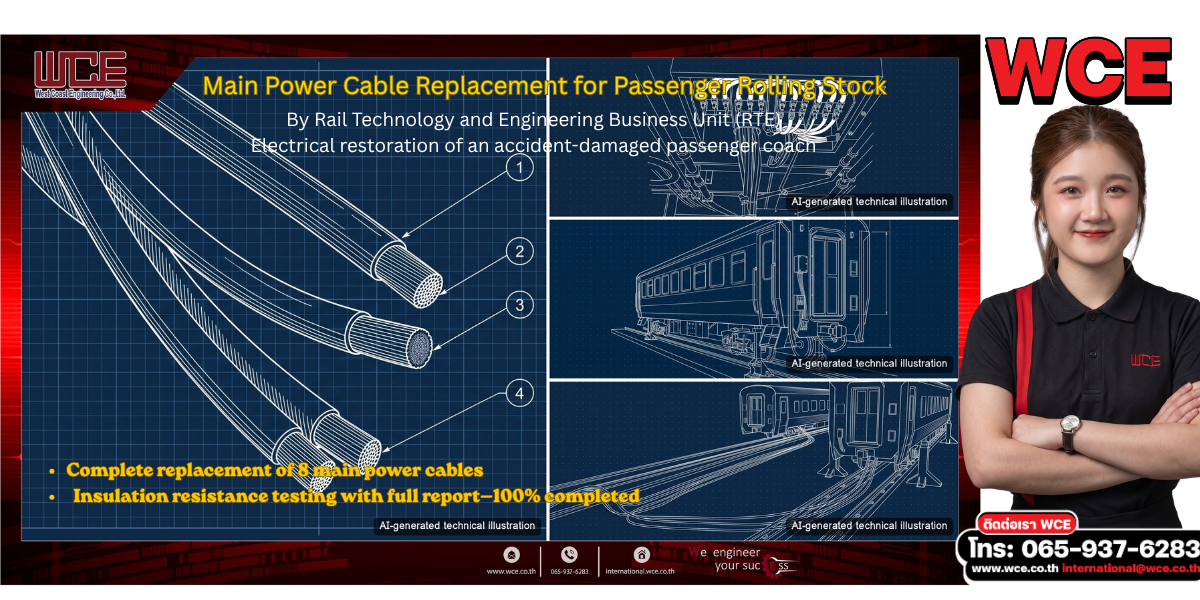
The cover image shows the key elements of the work. The large image on the left shows stripped main power cable ends, ready for termination. On the right, from top to bottom, you can see an underframe terminal box, a coach on lifting jacks, and inter-car cable routing. AI created all images as technical illustrations. They are not site photographs, and they do not identify any person, client, or vehicle.
WCE’s Rail Technology and Engineering Business Unit (RTE) provides engineering and maintenance services for railway rolling stock. Our work includes coaching electrical systems, from cable replacement and installation to testing and reporting.
Contact: +66 65-937-6283 | international@wce.co.th | www.wce.co.th
We engineer your success.
[1] CENELEC. EN 50343:2024 Railway applications – Rolling stock – Rules for installation of cabling. https://evs.ee/en/evs-en-50343-2024 (accessed 8 Oct 2026)
[2] CENELEC. EN 50264-1:2008 Railway applications – Railway rolling stock power and control cables having special fire performance – Part 1: General requirements. https://www.evs.ee/en/evs-en-50264-1-2008 (accessed 8 Oct 2026)
[3] American Public Transportation Association (APTA). APTA PR-E-RP-016-99, Rev. 2: 480 Vac Head End Power System. 2026. https://www.apta.com/wp-content/uploads/2019/12/APTA-PR-E-RP-016-99_R2.pdf (accessed 8 Oct 2026)
[4] Megger. A Stitch in Time: The Complete Guide to Electrical Insulation Testing. 2006. https://weh.maritime.edu/EN-3111/references/a-stitch-in-time.pdf (accessed 8 Oct 2026)—a commercial source from a test-equipment manufacturer
[5] BSI. BS EN 50264-2-1:2008 Railway rolling stock power and control cables having special fire performance—cables with crosslinked elastomeric insulation—single-core cables. BSI Knowledge (accessed 8 Oct 2026)

