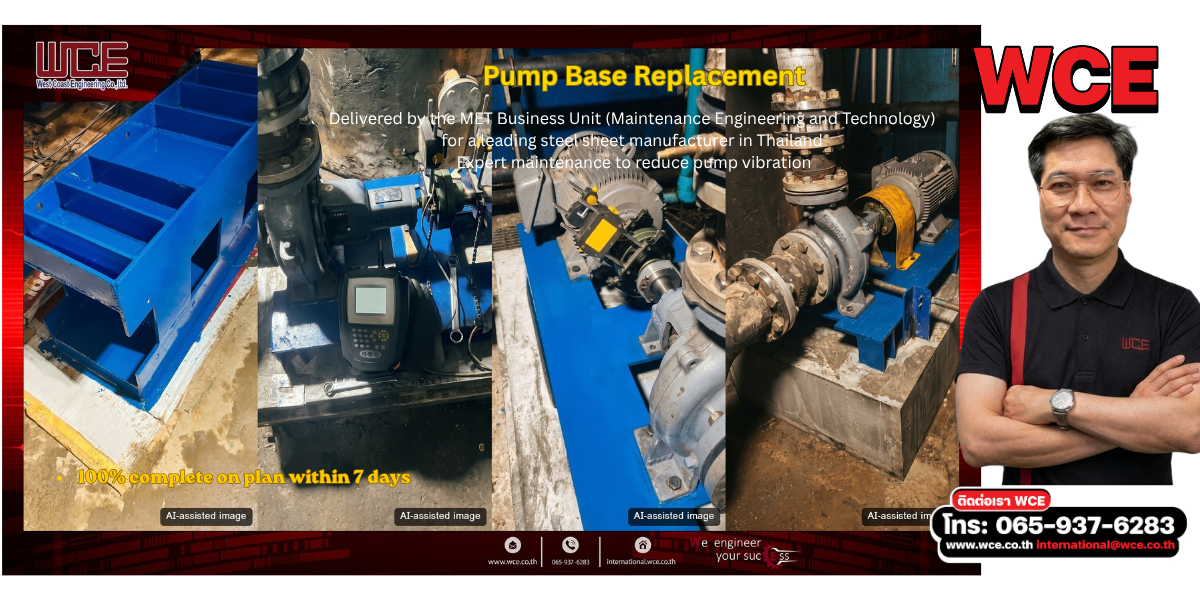
High vibration in pump-motor sets often relates to how the machine is supported and aligned, not only to the pump itself. This article summarizes four relevant principles (soft foot, shaft misalignment, baseplate installation and grouting, and vibration criteria) with cited sources, then compares them with a case study: a water pump base replacement carried out by WCE’s MET business unit during a plant shutdown.
1. What a pump base does
A pump baseplate holds the pump and motor in line on a concrete foundation and carries their weight and dynamic loads during operation. When the base degrades or is installed poorly, the typical symptom is higher vibration, which can accelerate bearing and seal wear.
2. Relevant principles
2.1 Soft foot
Piotrowski (2010) [5] describes soft foot as one or more machine feet not making good contact with the base, which complicates shaft alignment and is associated with elevated 1x vibration. Correction, therefore, starts with a flat base and feet that sit evenly before shaft alignment [4][5].
2.2 Shaft misalignment
Sekhar and Prabhu (1995) [6] used finite element modelling to show that coupling misalignment adds reaction forces and moments to the rotor system and raises vibration harmonics. Piotrowski (2006) [4] compiles alignment methods, including electro-optic (laser-based) techniques.
2.3 Baseplate installation and grouting
API RP 686 [7] is widely referenced for machinery installation and epoxy grouting. A grout manufacturer’s technical bulletin [8] states that the function of grout is to completely fill the space between the equipment and the concrete foundation and that a bonded (“locked”) foundation system transfers load and dampens vibration better than an unbonded one. (The latter is a manufacturer’s statement and should be read together with [7].)
2.4 Vibration criteria
ISO 20816-1:2016 [1] gives general guidelines for measuring and evaluating machine vibration. ISO 20816-3:2022 [2] applies to industrial machinery above 15 kW operating between 120 and 30,000 r/min and replaces ISO 10816-3:2009. For rotodynamic pumps, ANSI/HI 9.6.4-2022 [3] covers measurement on bearing housings and allowable values for factory and field tests. The appropriate criterion depends on machine type and power and on the agreement with the asset owner.
3. Case study: WCE water pump base replacement
The facts in this section are project facts, not citations.
– Performed by: Maintenance Engineering and Technology (MET) business unit, WCE
– Client: a leading steel sheet manufacturer in Thailand
– Timing: plant shutdown, August 2026, 7 days
– Scope: replace the base of a water pump to reduce vibration of the pump set
– Outcome: completed 100% on plan
The cover image (AI-assisted, based on site photographs) shows four stages from left to right: a newly fabricated and painted steel base, measurement with a vibration analyzer, shaft alignment between pump and motor using a laser tool, and the pump set installed on the new base and concrete foundation. This sequence mirrors sections 2.1 to 2.4: a correct base, installation, shaft alignment, and then measurement to confirm.
4. Observations from the case
1) Vibration problems should be treated as a system: base, installation, and shaft alignment together, not a single component.
2) Shutdown windows are short; planning the sequence in advance (preparing the new base before the outage) helps the work finish on plan.
3) Measuring before handover lets the result be confirmed with data.
5. WCE services
WCE’s MET business unit provides plant maintenance services, including preventive maintenance (PM), shutdown maintenance, and operation and maintenance (O&M).
Contact: +66 65-937-6283 | international@wce.co.th | www.wce.co.th
We engineer your success.
References
(Same list as the Thai version, [1]–[8]. Accessed 1 October 2026.)

