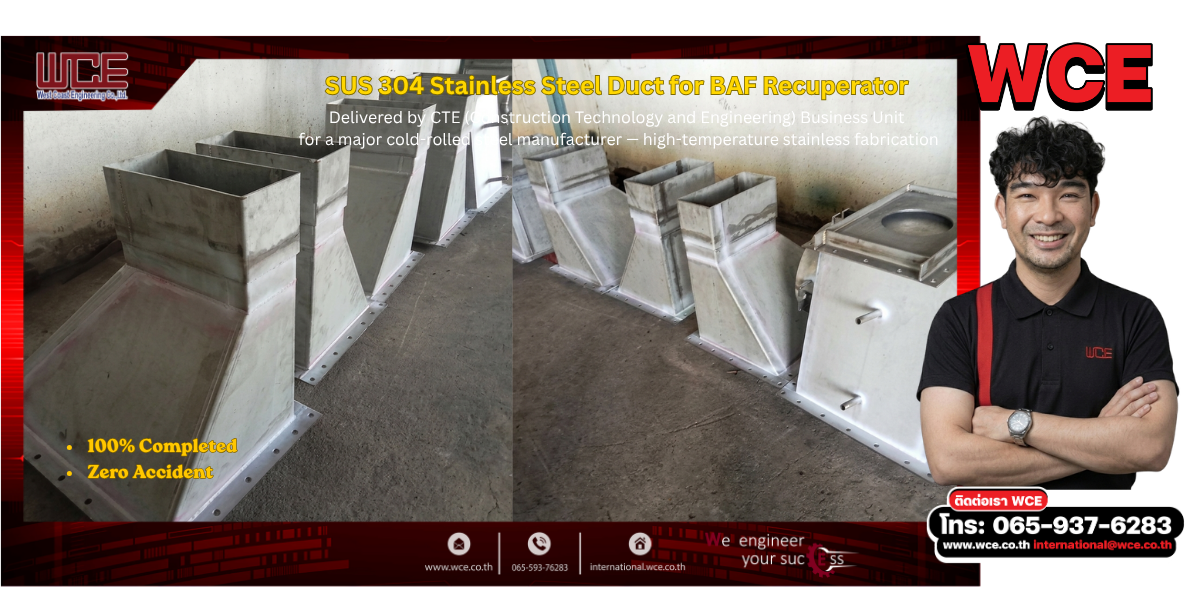
The Batch Annealing Furnace (BAF) is a critical process unit in cold-rolled steel production, restoring the ductility and workability of steel after cold rolling. The recuperator—a heat exchanger installed in the BAF exhaust system—recovers waste heat from flue gases to preheat combustion air, significantly improving furnace energy efficiency. The ductwork connecting the recuperator must withstand high temperatures and corrosive exhaust gases, requiring fabrication from high-grade stainless steel such as SUS 304. This article examines BAF technology, recuperator systems, stainless steel fabrication principles, applicable standards, and a real-world project reference demonstrating WCE’s capabilities.
The batch annealing furnace processes cold-rolled steel coils in batch cycles. Multiple coils are stacked on a base, covered with an inner cover and furnace hood, and then slowly heated to the target annealing temperature (approximately 600–720°C for low-carbon steel) before controlled cooling. This process restores ductility and reduces hardness in work-hardened steel [1].
A recuperator is a heat exchanger installed in the BAF exhaust system that transfers thermal energy from hot flue gases to incoming combustion air before it reaches the burners. The system reduces fuel consumption by 10–30%, lowers exhaust gas temperatures before atmospheric discharge, improves combustion efficiency through preheated air supply, and reduces greenhouse gas emissions [2].
The ductwork connecting the BAF to the recuperator must withstand extreme conditions: high temperatures (flue gas temperatures may reach 400–800°C), chemical corrosion from combustion gases containing SO₂ and moisture, thermal expansion, and vibration from furnace systems and fans. Hanger metal components are the structural brackets and supports that suspend and restrain the ductwork, designed to carry the duct’s weight while accommodating thermal movement [3].
SUS 304 (equivalent to AISI 304 or EN 1.4301) is an austenitic stainless steel with a nominal composition of 18% Cr and 8% Ni. Its key properties include excellent corrosion resistance across diverse environments, good high-temperature performance up to approximately 870°C for continuous service, excellent formability and weldability, non-magnetic when solution annealed, and an attractive, easily cleaned surface finish, per ASTM A240 [4].
Fabrication of SUS 304 components for high-temperature service requires attention to several specific factors:
The fabrication process for stainless steel recuperator ductwork involves drawing review to confirm dimensions, geometry, and material specifications; procurement of SUS 304 material with mill certificates; cutting and forming per engineering drawings; assembly and welding using qualified TIG/MIG procedures per approved WPS; weld inspection through VT and NDT; cleaning and passivation; final dimensional inspection; and packing and delivery [10].
| Item | Details |
|---|---|
| Project Name | BAF Duct Fabrication for New Recuperator and Hanger Metal Modification |
| Client | A major cold-rolled steel manufacturer in Thailand |
| Business Unit | CTE — Construction Technology and Engineering |
| Material | Stainless Steel SUS 304 |
| Scope | Fabrication of stainless steel ductwork and modification of hanger metal components, with delivery to client site |
| Project Duration | 18 April – 25 June 2026 (approximately 68 days) |
| Status | 100% Completed on schedule |
| Safety Record | Zero Accident |
1. High-Quality SUS 304 Stainless Steel Fabrication The recuperator ductwork required fabrication from SUS 304 stainless steel to withstand high temperatures and corrosive flue gas conditions. The WCE team executed fabrication using qualified welding processes in a dedicated stainless steel work area, with strict contamination prevention protocols.
2. Hanger Metal Modification In addition to new duct fabrication, the team modified the existing hanger metal support components to accommodate the new recuperator configuration.
3. On-Schedule Delivery All fabricated components were completed and delivered to the client’s site within the planned schedule.
[1] Roberts, W.L. (1978). Cold Rolling of Steel. Marcel Dekker, Inc., New York.
[2] Trinks, W., Mawhinney, M.H., Shannon, R.A., Reed, R.J. & Garvey, J.R. (2004). Industrial Furnaces, 6th Edition. John Wiley & Sons, Inc.
[3] SMACNA. (2005). HVAC Duct Construction Standards — Metal and Flexible, 3rd Edition. Sheet Metal and Air Conditioning Contractors’ National Association.
[4] ASTM International. (2022). ASTM A240/A240M — Standard Specification for Chromium and Chromium-Nickel Stainless Steel Plate, Sheet, and Strip. West Conshohocken, PA.
[5] IMOA (International Molybdenum Association). (2014). Practical Guidelines for the Fabrication of Stainless Steels. London.
[6] AWS. (2019). AWS D1.6/D1.6M — Structural Welding Code — Stainless Steel. American Welding Society.
[7] ASM International. (2005). ASM Specialty Handbook: Stainless Steels. ASM International, Materials Park, OH.
[8] ASME. (2021). ASME Boiler and Pressure Vessel Code, Section IX — Welding, Brazing, and Fusing Qualifications. American Society of Mechanical Engineers.
[9] ASTM International. (2022). ASTM A480/A480M — Standard Specification for General Requirements for Flat-Rolled Stainless and Heat-Resisting Steel Plate, Sheet, and Strip. West Conshohocken, PA.
[10] Bhadeshia, H. & Honeycombe, R. (2017). Steels: Microstructure and Properties, 4th Edition. Butterworth-Heinemann, Elsevier.
WCE delivers stainless steel and carbon steel fabrication, industrial ductwork, heat exchanger components, and all types of structural steel production. Our certified fabrication facility, qualified welders, and rigorous quality management ensure the highest standards.
📞 Tel: +66 65-937-6283 📧 Email: international@wce.co.th 🌐 Website: www.wce.co.th
We engineer your success.

