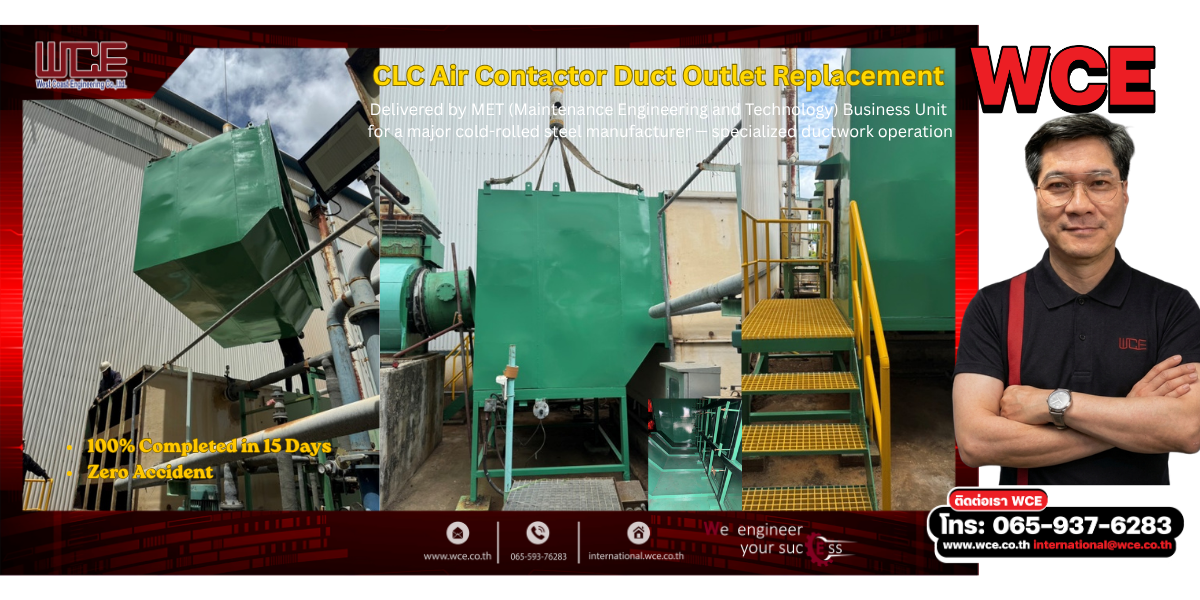
The air contactor system plays a vital role in cold-rolled steel production, managing temperature control and atmospheric conditions along the processing line. The air duct network connecting to the air contactor—particularly the outlet adapter—is subject to continuous thermal stress, chemical exposure, and mechanical vibration, necessitating periodic replacement to maintain system efficiency. This article examines the engineering principles of industrial air duct systems, applicable design and safety standards, and a real-world project reference demonstrating WCE’s capabilities.
An air contactor is a heat and mass transfer device used within the Continuous Line Cooling (CLC) section of cold-rolled steel production lines. Its primary functions include controlling strip temperature after the cold rolling process, providing surface cleaning of the steel strip, and maintaining a controlled atmosphere within the CLC section to prevent oxidation on the steel surface [1].
The air duct system connected to the air contactor comprises several critical components: the inlet duct, which delivers air from the fan or blower into the air contactor unit; the outlet duct, which channels processed air to exhaust or treatment systems; the outlet adapter, which serves as the transition piece between the contactor body and the main duct—a component frequently subject to replacement due to combined thermal, pressure, and corrosion loading; dampers for airflow regulation; and expansion joints to accommodate thermal expansion [2].
Industrial ductwork design must account for multiple factors, guided by established international standards:
Ductwork materials in a steel manufacturing environment must withstand elevated temperatures exceeding 200°C at certain points along the production line; chemical corrosion from coolant mist and process chemicals; vibration from surrounding machinery; and internal pressure—both positive and negative. Common material specifications include carbon steel per ASTM A36 or equivalent SS400 for general-purpose applications and stainless steel grades 304 or 316 for environments with high corrosion exposure [6].
Duct sizing follows the Equal Friction Method or Static Regain Method as recommended in the ASHRAE Fundamentals Handbook, considering required airflow volume (CFM or m³/h), appropriate duct velocity (typically 10–20 m/s for industrial applications), acceptable pressure drop across the system, and cross-sectional geometry (circular, rectangular, or specialty profiles) [4].
Replacing a duct outlet in an operating steel production facility presents several engineering and logistical challenges:
Ductwork removal and installation in industrial facilities must comply with the following safety standards:
| Item | Details |
|---|---|
| Project Name | CLC Air Contactor Duct Outlet Change |
| Client | A major cold-rolled steel manufacturer in Thailand |
| Business Unit | MET — Maintenance Engineering and Technology |
| Scope | Removal and installation of an air duct outlet adapter for the CLC Air Contactor system |
| Project Duration | 8–22 June 2026 (15 days) |
| Status | 100% Completed on schedule |
| Safety Record | Zero Accident |
1. Specialized Ductwork Removal and Installation Expertise This project required a team with specialized competency in industrial ductwork handling. The scope involved removing the existing deteriorated duct outlet and installing a new replacement adapter—all performed at elevation and within the confined spaces surrounding the cold-rolled steel production line equipment. The WCE team maintained strict compliance with LOTO procedures and deployed full PPE throughout the operation.
2. Precision Connection and Sealing The new duct outlet adapter required precise alignment and connection to both the air contactor body and the main duct run. The team performed prefabrication dimensional verification and post-installation testing to confirm leak-free operation and full system integrity.
3. On-Schedule Delivery The project was completed within the planned 15-day duration, coordinated with the client’s production team to minimize downtime impact on the manufacturing line.
[1] Roberts, W.L. (1978). Cold Rolling of Steel. Marcel Dekker, Inc., New York.
[2] ASHRAE. (2020). ASHRAE Handbook — HVAC Systems and Equipment, Chapter 1: HVAC System Analysis and Selection. American Society of Heating, Refrigerating and Air-Conditioning Engineers.
[3] SMACNA. (2005). HVAC Duct Refrigerating,Standards — Metal and Flexible, 3rd Edition. Sheet Metal and Air Conditioning Contractors’ National Association.
[4] ASHRAE. (2021). ASHRAE Handbook — Fundamentals, Chapter 21: Duct Design. American Society of Heating, Refrigerating and Air-Conditioning Engineers.
[5] NFPA. (2020). NFPA 91: Standard for Exhaust Systems for Air Conveying of Vapors, Gases, Mists, and Particulate Solids. National Fire Protection Association.
[6] ASTM International. (2019). ASTM A36/A36M — Standard Specification for Carbon Structural Steel. West Conshohocken, PA.
[7] SMACNA. (2012). HVAC Air Duct Leakage Test Manual, 2nd Edition. Sheet Metal and Air Conditioning Contractors’ National Association.
[8] OSHA. (2023). 29 CFR 1926 Subpart M — Fall Protection. Occupational Safety and Health Administration, U.S. Department of Labor.
[9] OSHA. (2023). 29 CFR 1910.146 — Permit-Required Confined Spaces. Occupational Safety and Health Administration, U.S. Department of Labor.
[10] OSHA. (2023). 29 CFR 1910.147 — The Control of Hazardous Energy (Lockout/Tagout). Occupational Safety and Health Administration, U.S. Department of Labor.
WCE delivers specialized industrial ductwork removal and installation, ventilation system services, and machinery maintenance across all industry sectors. Our experienced engineering teams and technicians operate to international safety standards, ensuring quality and reliability in every project.
📞 Tel: +66 65-937-6283 📧 Email: international@wce.co.th 🌐 Website: www.wce.co.th
We engineer your success.

