An electrostatic precipitator (ESP) is an air pollution control unit used in many industrial plants. It stands on a tall steel structure, with walkways and guardrails for maintenance access. Over time, the structure and walkways degrade. This article explains what an ESP does, why ESP structure repair matters, and the general rules for guardrails. Finally, it presents an ESP structure repair and painting case study by WCE’s MET business unit.
Inside an ESP, rows of metal plates stand side by side with high-voltage electrodes between them. As exhaust gas flows through, the electrodes charge the dust particles. Then the electric field drives the dust onto the collector plates. New designs typically reach 99% to 99.9% collection efficiency [1].
Many palm oil mills burn fibre and shell as boiler fuel, so they must control dust in their exhaust. An article by the Malaysian Palm Oil Board lists ESPs as one option. Their strengths include a small footprint, low operating costs, and dry ash [3].
Corrosion can occur in an ESP from air leakage and acid condensation [1]. In addition, the outdoor steel structure around the unit faces heat, dust, and moisture. Therefore, repairing damaged members and repainting at intervals keeps the ESP structure strong over the long term.
Walkways at height need strong guardrails. For example, US OSHA rules set the top rail at 42 inches (about 107 cm), plus or minus 3 inches. The top rail must withstand at least 200 pounds (about 890 N), and midrails at least 150 pounds [2]. For this reason, damaged walkway floors must be reinforced before reuse.
Repairing a structure at height needs stable scaffolding, fall protection, and an experienced crew. As a result, the work can proceed safely and finish on plan.
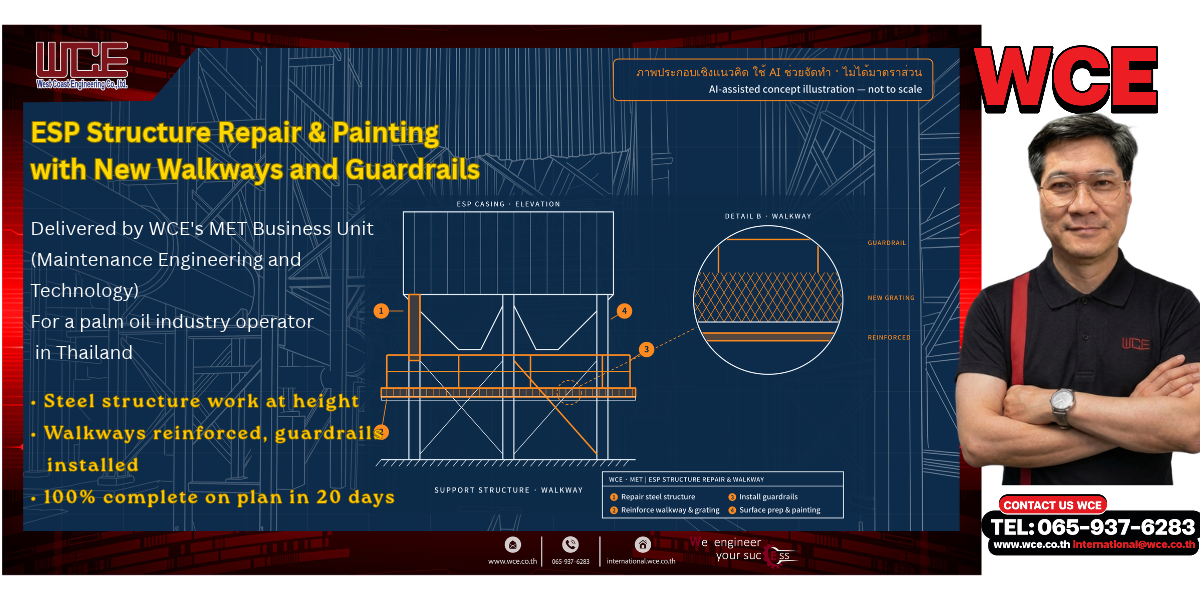
This project relied on the MET team’s skill in working at height. First, the team repaired damaged steel members. Next, it replaced the walkway floors and reinforced the steel. Then it installed the guardrails. Finally, the team prepared the surfaces and painted the structure. As a result, the work finished on plan in 20 days.
The cover image is a concept illustration. In the background, a perspective line drawing shows the structure under the ESP building. On the right, a side view shows the ESP and its supports, with the walkway and guardrails highlighted in orange. A detail view shows the walkway grating and reinforcement plate, with the four work steps below. All images were created with AI assistance, so no person or client can be identified.
An ESP must keep running to control emissions. For this reason, ESP structure repair must finish quickly. In addition, safety at height matters as much as the quality of the work.
WCE’s MET (Maintenance Engineering and Technology) business unit maintains machinery and structures in industrial plants, including steel structure work at height.
Contact: +66 65-937-6283 | international@wce.co.th | www.wce.co.th
We engineer your success.

