Many industrial treatment ponds carry equipment on floating units. As a result, the equipment works at the water surface even when the pond level changes. This article explains the role of floating equipment in treatment ponds and why floats degrade. It also covers the key points of repair and installation. Finally, it presents a case study: floating unit fabrication, refurbishment, and installation by WCE’s MTE business unit.
Surface aerated ponds combine mechanical aeration with natural processes. The aerators keep dissolved oxygen near the surface at about 2 mg/L or higher. In addition, ponds use both fixed and floating surface aerators [1]. Floating equipment rests on floats and a steel frame that supports the motor and other parts.
A floating unit needs enough buoyancy to carry its steel frame and equipment. It must also spread the load evenly. Therefore, the unit floats level and runs steadily. A cross-shaped frame with a float at each end is one layout that keeps the unit stable.
Plastic floats outdoors face constant UV exposure. One study of HDPE floats found that tensile strength fell from 23.22 MPa to 14.64 MPa after accelerated UV testing. However, the material could still carry load, and the authors suggested UV-stabilised HDPE [2]. For this reason, regular float inspections help plants repair or replace them in time.
Wastewater guidance recommends servicing surface aerators twice a year. It also lists mechanical breakdown of aerators as a common problem [1]. As a result, refurbishing floats and frames is part of keeping the treatment system running.
A floating unit with its steel frame is large. Therefore, installation needs a crane to lift it over the pond edge and lower it carefully onto the water. Next, the team positions the unit and secures it to the pond side.
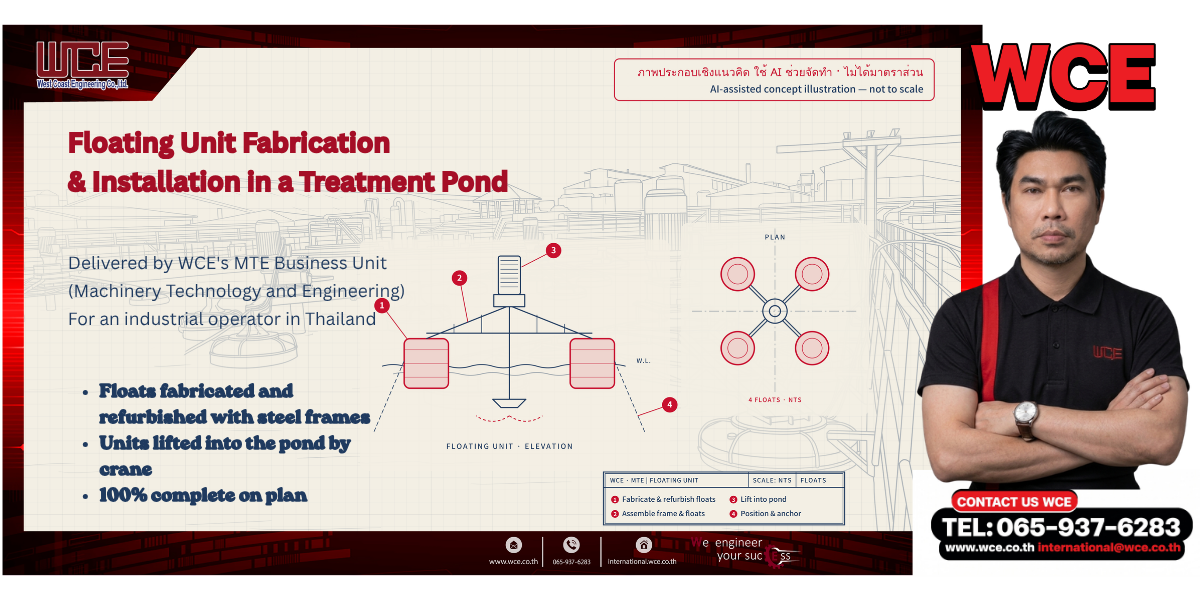
First, the MTE team fabricated and refurbished the floats. Next, it assembled the floats onto the steel frames. Then the team lifted each unit into the pond by crane. Finally, it positioned the units in the pond. As a result, the work finished on plan.
The cover image is a concept illustration. In the background, a perspective line drawing shows a treatment pond with several floating units. On the right, a side view shows a floating unit at the water line, with a plan view of the cross frame and four floats. Red highlights mark the floats. The four work steps complete the drawing. All images were created with AI assistance, so no person or client can be identified.
Work in a treatment pond differs from work inside a plant because the team works near and on the water. For this reason, lift planning and crew safety matter as much as the quality of the floats.
WCE’s MTE (Machinery Technology and Engineering) business unit manufactures, repairs, and installs industrial machinery and equipment, including plant utility equipment.
Contact: +66 65-937-6283 | international@wce.co.th | www.wce.co.th
We engineer your success.

