Cold rolling mills use bell-type annealing furnaces to treat steel coils after rolling. This step restores the mechanical properties of the sheet. A key part of the furnace is the inner cover, which encloses the coils and holds a protective atmosphere. This article explains how a bell annealing furnace works and what the inner cover does. It also covers the main points of inner cover repair. Finally, it presents a case study: the repair of seven inner covers by WCE’s CTE business unit.
In batch annealing, coils stand stacked on an annealing base. First, an inner cover is lowered over the stack and sealed to the base. Next, an outer cover with burners fits over it. The burners heat the outside of the inner cover, which then radiates heat to the coils. Meanwhile, a base fan circulates the protective atmosphere to move heat through the stack [1]. A single cycle typically runs from about 20 hours to several days [1].
The inner cover keeps the protective atmosphere, such as nitrogen, hydrogen, or HNX, around the coils and apart from the outside space [1]. In addition, metallurgical research shows that a hydrogen atmosphere helps remove rolling oil residue during annealing. Adjusting heat flow in the cover also improves temperature uniformity inside the coil [3]. Therefore, a well-sealed inner cover directly affects surface quality and sheet properties.
The inner cover is a tube with a closed top. Its wall is a thin steel sheet with transverse corrugations. These corrugations add strength and rigidity to the shell [2].
Inner covers are large and heavy. In addition, they face a wide range of temperatures in every cycle. Different expansion and contraction between parts can break welds, especially at the crane lifting brackets [2]. For this reason, repair work must focus on weld quality and inspection before reuse.
AWS D1.1 Structural Welding Code – Steel covers procedure and welder qualification, fabrication, inspection, and weld acceptance criteria [4]. As a result, weld inspection is a key step before any steel part goes back into service.
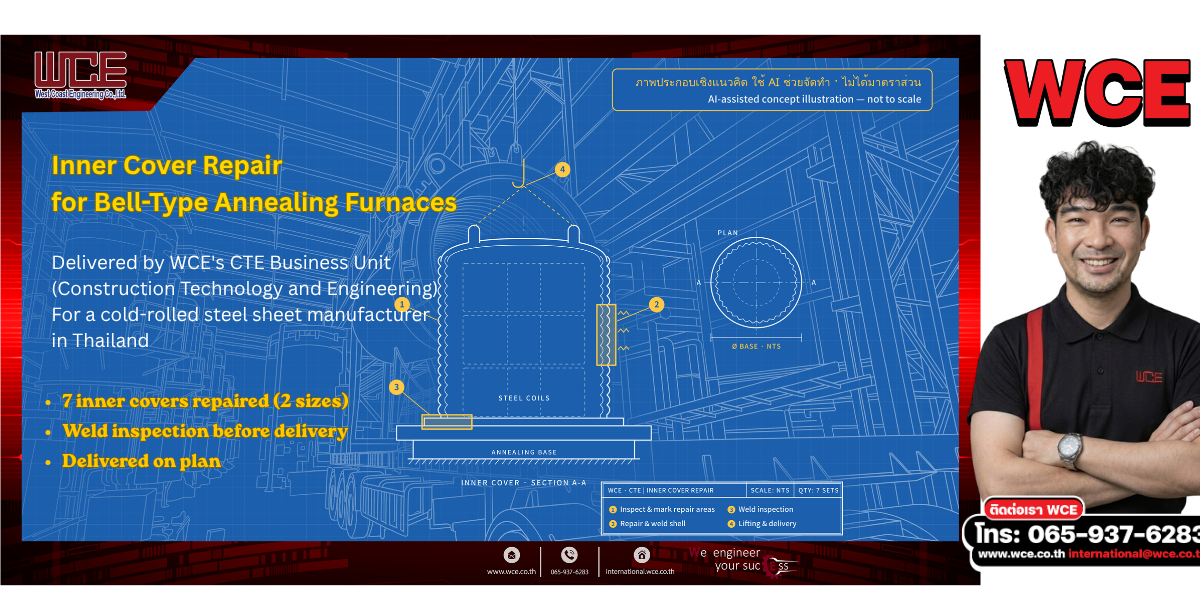
First, the CTE team inspected each cover and marked the repair areas. Next, it repaired and welded the shell. Then the team inspected the welds before delivery. Finally, it lifted the covers onto trucks and delivered them to the client on plan.
The cover image is a concept illustration. In the background, a perspective line drawing shows an inner cover on a trailer inside the plant. On the right, a section view shows the inner cover over a coil stack on its base, with a plan view beside it. Yellow highlights mark the repair areas. The four work steps complete the drawing. All images were created with AI assistance, so no person or client can be identified.
Inner covers rotate through the production line. For this reason, repairing them reduces furnace downtime and extends equipment life. In addition, a multi-set repair contract needs a clear sequence, so each delivery fits the client’s furnace schedule.
WCE’s CTE (Construction Technology and Engineering) business unit fabricates, repairs, and installs steel structures and components for industrial plants.
Contact: +66 65-937-6283 | international@wce.co.th | www.wce.co.th
We engineer your success.

