Many large wind turbine towers now use precast concrete elements in their lower sections. This type of construction needs strong, accurate steel equipment to support the concrete parts. This article gives an overview of concrete and hybrid wind towers. It also explains the key principles of rack fabrication, from welding to surface protection. Finally, it presents a case study: a steel rack for concrete blocks, built in four sets by WCE’s CTE business unit.
Wind turbines keep getting larger. As a result, towers must rise higher to reach stronger and steadier wind. Many towers now exceed 100 m. For this reason, some manufacturers have developed hybrid towers that use high-strength precast concrete elements [2]. In addition, a study for the US National Renewable Energy Laboratory (NREL) assessed hybrid towers with a concrete base of about 47–49 m and a steel upper section. The study also developed a segmental precast concrete approach [1].
A rack that supports concrete parts must carry the load safely. It must also match the drawing, so each block sits in the right position. Typically, rolled steel sections form the main frame. Cross members add stiffness, and vertical posts stand at the designed locations.
AWS D1.1 Structural Welding Code – Steel applies to load-bearing steel structures. It covers procedure and welder qualification, fabrication and workmanship, and inspection and weld acceptance criteria [3]. Therefore, weld quality sits at the heart of any load-bearing steel work.
Steel equipment on an outdoor construction site faces both sun and rain. The ISO 12944 series covers corrosion protection of steel structures with protective paint systems [4]. Consequently, proper surface preparation and painting help a steel rack last longer.
Each rack is large and heavy. For this reason, the team must plan lifting points, loading order, and transport to the site. This step needs the same safety control as fabrication.
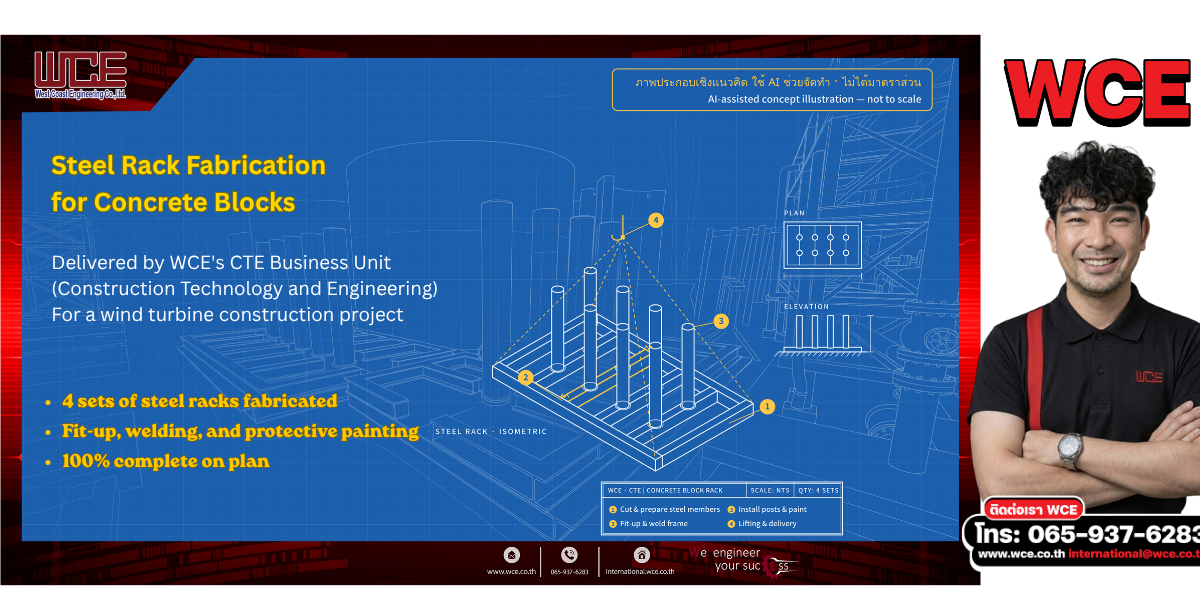
First, the CTE team cut and prepared the steel members. Next, it fitted up and welded each rack frame. Then the team installed the vertical posts and painted the racks. Finally, it lifted all four sets onto trucks and delivered them to the site. As a result, the work finished on the plan in 49 days.
The cover image is a concept illustration. In the background, a perspective line drawing shows the site. On the right, an isometric drawing shows the rack, with plan and elevation views beside it. Yellow dashed lines show the lifting arrangement. The four work steps complete the drawing. All images were created with AI assistance, so no person or client can be identified.
Equipment for renewable energy projects must arrive in time for the construction schedule. In addition, building several sets at once means every set must match in size. For this reason, the team planned lifting and transport from the start.
WCE’s CTE (Construction Technology and Engineering) business unit fabricates and installs steel structures. Its services include steel equipment for construction projects.
Contact: +66 65-937-6283 | international@wce.co.th | www.wce.co.th
We engineer your success.

