Hot rolling mills use high-pressure water to remove oxide scale from steel before rolling. This process is called descaling. Its backbone is the high-pressure descaling piping that carries water from the pumps to the nozzles. This article explains how descaling works and what affects its performance. It also covers general requirements for pressure piping. Finally, it presents a case study: an upgrade of the main descale pump pipe by WCE’s MET business unit.
Steel reacts with oxygen while it is reheated before rolling. As a result, a layer of oxide scale forms on the surface. If the mill does not remove it, the rolls press the scale into the product surface [1]. In addition, the scale damages the surface and wears the work rolls [3]. For this reason, hot rolling mills install descalers with high-pressure water nozzles [1].
A water jet hits the steel with two forces: impact and shear. Of these, impact force does most of the work. One study measured jet velocities above 130 m/s at a spray pressure of 20 MPa [2]. Impact rises with higher pressure and flow rate. However, it falls as the nozzle distance or spray angle increases [2].
For example, one study of a hot strip mill descaler describes two header pairs. The front pair runs at about 21 MPa. Meanwhile, the rear pair runs at about 30–38 MPa [3]. Therefore, every pipe, fitting, and flange in the line must handle these pressures safely.
A single nozzle cannot cover the full strip width. Consequently, the sprays must overlap. Poor offset angles leave more residual scale next to the overlap zones. The researchers suggest adjusting nozzle angles rather than raising water pressure, which wastes energy [1].
ASME B31.3 Process Piping covers the full lifecycle of plant piping. It sets requirements for materials, design, fabrication, erection, examination, inspection, and testing [4]. In practice, repairs to high-pressure descaling piping therefore focus on weld quality, flange alignment, and pressure testing before restart.
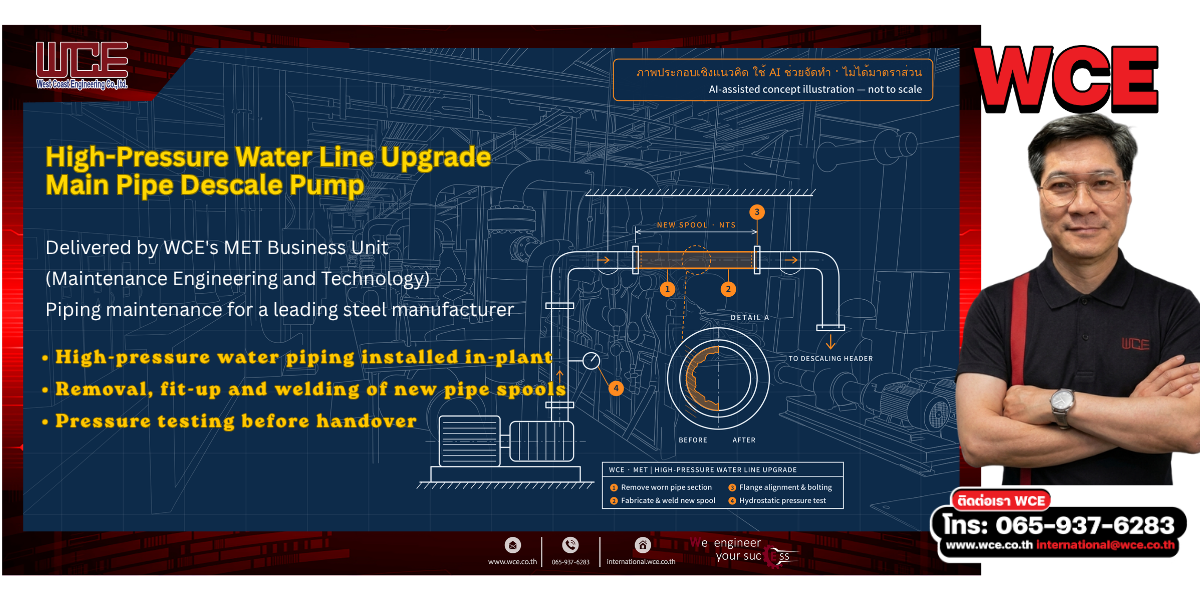
This project drew on MET’s expertise in high-pressure water piping inside operating plants. First, the team removed the old pipe section. Next, it fabricated and welded a new spool and aligned the flanges. Finally, the team pressure-tested the line before handover. As a result, the descaling system returned to service in line with the production plan.
The cover image is a concept illustration. In the background, a perspective line drawing shows a pump room. On the right, a diagram traces the line from the pump to the main pipe. An orange highlight marks the new pipe section. A Detail: A cross-section and the four work steps complete the drawing. All images were created with AI assistance, so no person or client can be identified.
Descaling directly affects steel surface quality. When it stops, the production line feels the impact. For this reason, maintenance on high-pressure descaling piping must fit the planned shutdown window. In addition, the work must be ready to hold operating pressure as soon as the system restarts.
WCE’s MET (Maintenance Engineering and Technology) business unit provides maintenance for industrial machinery and plant systems. Its services include installing and upgrading high-pressure piping.
Contact: +66 65-937-6283 | international@wce.co.th | www.wce.co.th
We engineer your success.

