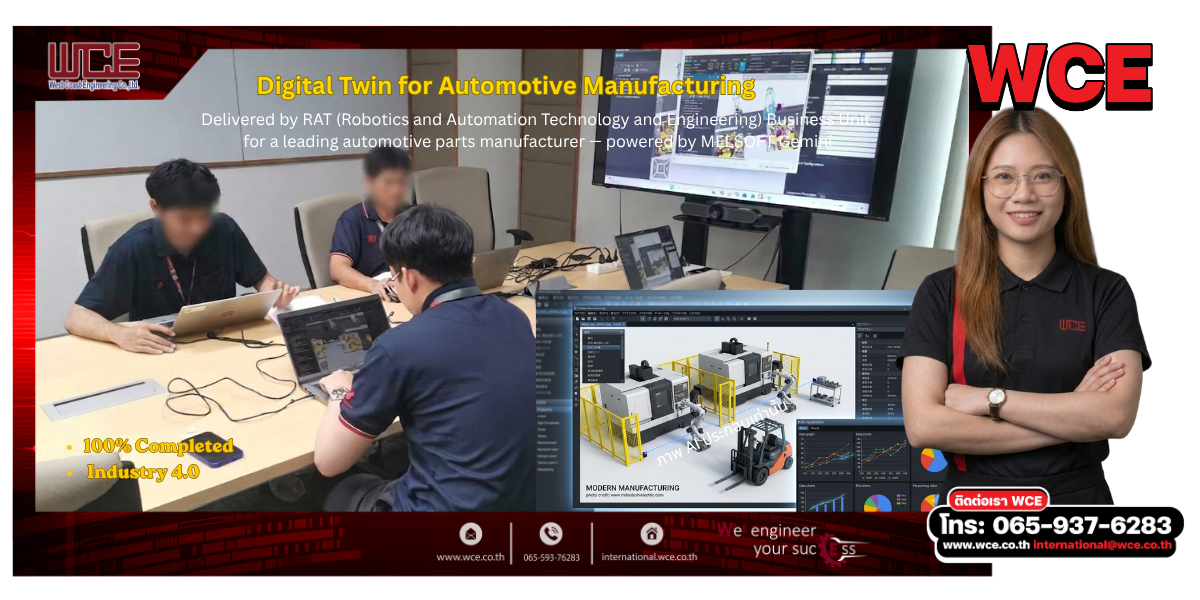
Digital twin technology is transforming manufacturing industries worldwide, particularly in the automotive sector, where production line complexity demands advanced simulation and optimization capabilities. The core principle involves creating a virtual replica of physical production systems, machines, or entire processes in digital form, connected to the real system in real time. This enables simulation, analysis, testing, and optimization without disrupting actual production. This article examines digital twin fundamentals, automotive industry applications, platform capabilities, and a real-world implementation by WCE.
A digital twin is a virtual replica of a physical asset, process, or system that receives real-time data from sensors, control systems (PLC/SCADA), and other data sources. This enables the virtual model to accurately mirror the state, behavior, and performance of the real-world system [1].
The concept was first introduced by Dr. Michael Grieves in 2002 at the University of Michigan and was subsequently developed extensively by NASA for spacecraft simulation before expanding into the broader manufacturing sector [2].
A digital twin system comprises three essential components working in concert: the physical entity—the actual machines, production line, or system being modeled; the virtual entity—the 3D model and mathematical simulations representing the system’s behavior; and the data connection—real-time bidirectional data exchange between the physical and virtual systems via industrial protocols such as OPC UA, MQTT, or Ethernet/IP [3].
Digital twins are classified by scope:
The automotive industry uses digital twins to simulate production lines before physical installation, verifying layout, machine positioning, and robot trajectories to prevent collisions; optimize cycle time by modeling work sequences to identify bottlenecks and determine optimal configurations; test changes through what-if scenarios—such as adding robots, changing work sequences, or adjusting conveyor speeds—before real-world implementation; and provide virtual training for operators to learn production systems through 3D models before working on the actual line [5].
Digital twins receive real-time sensor data to monitor machine condition (condition monitoring) and detect anomalies before failures occur, predict the remaining useful life (RUL) of components, plan maintenance proactively to reduce unplanned downtime, and lower overall maintenance costs [6].
By modeling the energy consumption of individual machines and entire production lines, digital twins identify energy waste, optimize equipment settings, and track energy KPIs in real time [7].
MELSOFT Gemini is a digital twin software platform from Mitsubishi Electric, designed specifically for integration with Mitsubishi Electric factory automation systems. Key capabilities include 3D simulation with direct PLC connectivity via GX Works and iQ-R Series; comprehensive modeling of robots, conveyors, sensors, and automation devices; virtual commissioning—testing PLC programs on the simulation before deployment; a standard library of Mitsubishi Electric device models ready for use; and support for open standards such as OPC UA for cross-platform connectivity [8].
For automotive parts manufacturers, Digital Twin technology reduces commissioning time and cost for new production lines through virtual commissioning; minimizes unplanned downtime through real-time machine condition monitoring; increases throughput through continuous cycle time simulation and optimization; supports rapid model changeovers—a critical automotive industry requirement; and enables the journey toward Industry 4.0 and Smart Factory transformation [13].
| Item | Details |
|---|---|
| Project Name | Digital Twin System Installation for Automotive Production |
| Client | A leading automotive parts manufacturer |
| Business Unit | RAT — Robotics and Automation Technology and Engineering |
| Platform | MELSOFT Gemini (Mitsubishi Electric) |
| Scope | System installation, configuration, training, and handover |
| Project Duration | 25–29 March 2026 (5 days) |
| Status | 100% Completed on schedule |
1. Digital Twin Solution for the Automotive Sector: WCE’s RAT business unit delivered a Digital Twin solution powered by MELSOFT Gemini to a leading automotive parts manufacturer. The system enables the client to simulate and analyze production lines in 3D, test PLC programs on the virtual model, and optimize manufacturing processes without disrupting actual production.
2. Rapid Installation with Comprehensive Training The WCE team completed system installation, configuration, and full user training for the client’s engineering team within 5 days.
3. Ongoing After-Sales Support: Beyond installation, WCE provides continuous technical support and maintenance services to ensure the client maximizes the value of their digital twin investment.
[1] Grieves, M. & Vickers, J. (2017). “Digital Twin: Mitigating Unpredictable, Undesirable Emergent Behavior in Complex Systems.” In Transdisciplinary Perspectives on Complex Systems, pp. 85–113. Springer.
[2] Glaessgen, E. & Stargel, D. (2012). “The Digital Twin Paradigm for Future NASA and U.S. Air Force Vehicles.” 53rd AIAA/ASME/ASCE/AHS/ASC Structures, Structural Dynamics and Materials Conference. AIAA 2012-1818.
[3] Tao, F., Zhang, H., Liu, A. & Nee, A.Y.C. (2019). “Digital Twin in Industry: State-of-the-Art.” IEEE Transactions on Industrial Informatics, 15(4), 2405–2415.
[4] Fuller, A., Fan, Z., Day, C. & Barlow, C. (2020). “Digital Twin: Enabling Technologies, Challenges and Open Research.” IEEE Access, 8, 108952–108971.
[5] Qi, Q. & Tao, F. (2018). “Digital Twin and Big Data Towards Smart Manufacturing and Industry 4.0: 360 Degree Comparison.” IEEE Access, 6, 3585–3593.
[6] Tao, F., Cheng, J., Qi, Q., Zhang, M., Zhang, H. & Sui, F. (2018). “Digital Twin-Driven Product Design, Manufacturing and Service with Big Data.” International Journal of Advanced Manufacturing Technology, 94, 3563–3576.
[7] Lu, Y., Liu, C., Wang, K.I.K., Huang, H. & Xu, X. (2020). “Digital Twin-Driven Smart Manufacturing: Connotation, Reference Model, Applications and Research Issues.” Robotics and Computer-Integrated Manufacturing, 61, 101837.
[8] Mitsubishi Electric Corporation. (2024). MELSOFT Gemini — 3D Simulator Software. Product Documentation. Tokyo, Japan.
[9] ISO. (2021). ISO 23247 — Automation Systems and Integration — Digital Twin Framework for Manufacturing. International Organization for Standardization.
[10] IEC. (2014). IEC 62714 — Engineering Data Exchange Format for Use in Industrial Automation Systems Engineering (AutomationML). International Electrotechnical Commission.
[11] IEC. (2020). IEC 62541 — OPC Unified Architecture. International Electrotechnical Commission.
[12] ISA. (2010). ISA-95 / IEC 62264 — Enterprise-Control System Integration. International Society of Automation.
[13] Rosen, R., von Wichert, G., Lo, G. & Bettenhausen, K.D. (2015). “About The Importance of Autonomy and Digital Twins for the Future of Manufacturing.” IFAC-PapersOnLine, 48(3), 567–572.
WCE delivers digital twin solutions, factory automation systems, industrial robotics, and Industry 4.0 technologies for the automotive industry and all manufacturing sectors. Our experienced automation engineers provide end-to-end solutions with ongoing after-sales support.
📞 Tel: +66 65-937-6283 📧 Email: international@wce.co.th 🌐 Website: www.wce.co.th
We engineer your success.

