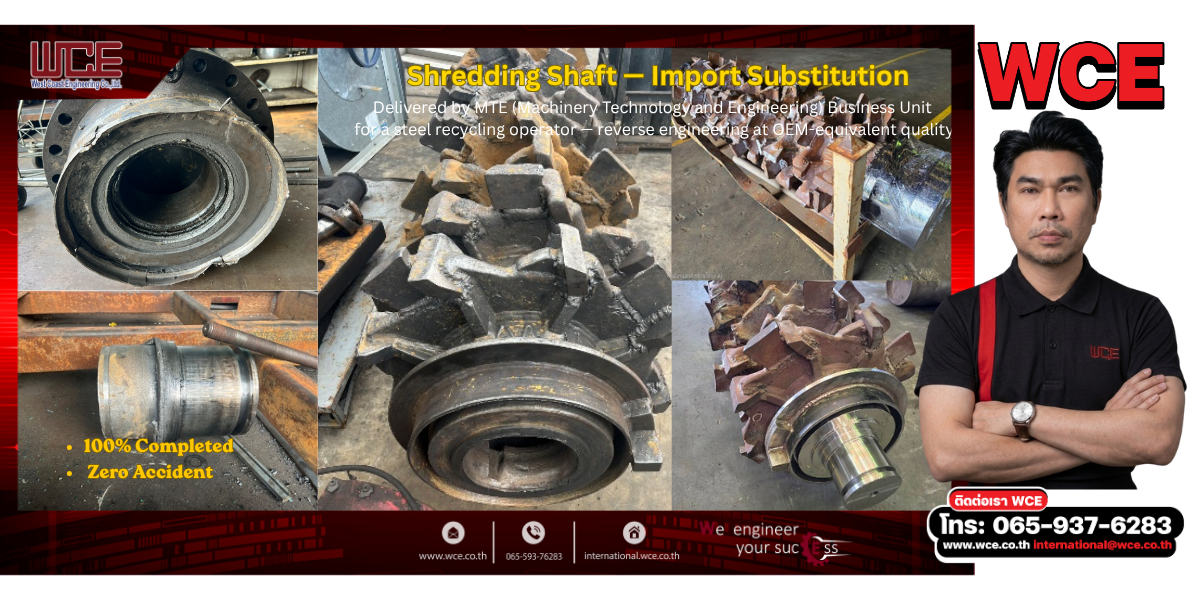
The Shredder is the core machine in steel recycling operations, responsible for tearing and reducing scrap metal to sizes suitable for electric arc furnace (EAF) melting. The main shaft of a shredder endures extreme operating conditions—high torque, repeated impact loads, and shear forces—making it one of the most failure-critical components. When a shaft fails due to fatigue fracture, sourcing OEM replacement parts from overseas manufacturers is both costly and time-consuming. Domestic reverse engineering and manufacturing offers a viable alternative that significantly reduces both cost and lead time. This article examines heavy-duty shaft engineering principles, the reverse engineering and manufacturing process, applicable standards, and a real-world project reference demonstrating WCE’s capabilities.
A scrap shredder is a large-scale machine used in the steel recycling industry to reduce scrap metal—including automobile bodies, appliances, and mixed ferrous scrap—into uniformly sized fragments suitable for EAF melting. The machine operates by rotating a hammer/rotor assembly mounted on the main shaft at high speed inside a shredding chamber. As scrap is fed into the machine, the hammers impact and tear the material into smaller pieces, which pass through a sizing grate to ensure consistent output dimensions [1].
Shredders operate under exceptionally demanding conditions. The main shaft must absorb high torque from large drive motors (typically rated at 1,000 horsepower or more), withstand repeated impact loads from shredding high-strength scrap materials, endure vibration caused by processing materials of irregular size and hardness, and resist the corrosive effects of metallic dust and harsh environmental exposure [2].
Designing a shaft for a shredder requires analysis of multiple factors:
Shaft materials for shredder applications require specific properties:
Shredder shafts fail through several mechanisms:
Producing a replacement shaft without OEM drawings requires a systematic reverse engineering approach:
Manufacturing replacement shafts domestically rather than importing OEM parts from overseas offers several significant advantages: substantial cost reduction compared to OEM import pricing, dramatically shorter lead times — from several months to a matter of weeks — reducing machine downtime, flexibility to improve materials or design features based on actual operating conditions, and support for domestic industrial capability and engineering expertise [13].
| Item | Details |
|---|---|
| Project Name | Shredding Shaft Repair — Manufacturing Replacement Shaft |
| Client | A steel recycling operator in Thailand |
| Business Unit | MTE — Machinery Technology and Engineering |
| Scope | Dimensional inspection of fractured shaft → New shaft manufacturing → Complete bearing set assembly |
| Project Duration | 1 April – 20 June 2026 (approximately 81 days) |
| Status | 100% Completed on schedule |
| Safety Record | Zero Accident |
1. Import Substitution — Significant Cost and Lead Time Reduction The primary achievement of this project was manufacturing a complete replacement Shredding shafts domestically, eliminating the need to source OEM parts from overseas. This delivered significant cost savings and reduced lead time from several months to approximately 11 weeks.
2. Comprehensive Reverse Engineering The WCE team executed the full reverse engineering process: dimensional inspection of the fractured original shaft, material analysis, engineering drawing preparation, material procurement with certification, precision machining, heat treatment, quality inspection including NDT, and complete bearing set assembly.
3. OEM-Equivalent Quality The manufactured shaft underwent comprehensive quality assurance at every stage — dimensional verification, hardness testing, and crack inspection — ensuring performance and reliability equivalent to OEM parts.
[1] Schlesinger, M.E. (2013). Aluminum Recycling, 2nd Edition. CRC Press.
[2] Worrell, E. & Reuter, M.A. (2014). Handbook of Recycling: State-of-the-art for Practitioners, Analysts, and Scientists. Elsevier.
[3] Budynas, R.G. & Nisbett, J.K. (2020). Shigley’s Mechanical Engineering Design, 11th Edition. McGraw-Hill Education.
[4] Dowling, N.E. (2013). Mechanical Behavior of Materials, 4th Edition. Pearson Education.
[5] ASTM International. (2022). ASTM A29/A29M — Standard Specification for General Requirements for Steel Bars, Carbon and Alloy, Hot-Wrought. West Conshohocken, PA.
[6] ASM International. (1991). ASM Handbook, Volume 4: Heat Treating. ASM International, Materials Park, OH.
[7] Stephens, R.I., Fatemi, A., Stephens, R.R. & Fuchs, H.O. (2001). Metal Fatigue in Engineering, 2nd Edition. John Wiley & Sons.
[8] ISO. (2010). ISO 286-1 — Geometrical Product Specifications (GPS) — ISO Code System for Tolerances on Linear Sizes. International Organization for Standardization.
[9] ASTM International. (2021). ASTM E709 — Standard Guide for Magnetic Particle Testing. West Conshohocken, PA.
[10] ISO. (2003). ISO 1940-1 — Mechanical Vibration — Balance Quality Requirements for Rotors in a Constant (Rigid) State. International Organization for Standardization.
[11] ASNT. (2016). Nondestructive Testing Handbook, 4th Edition. American Society for Nondestructive Testing.
[12] ASTM International. (2022). ASTM A370 — Standard Test Methods and Definitions for Mechanical Testing of Steel Products. West Conshohocken, PA.
[13] Office of Industrial Economics. (2023). Thailand Steel Industry Development Plan. Ministry of Industry, Thailand.
WCE delivers specialized replacement part manufacturing, reverse engineering, precision machining, and heavy-duty shaft and machinery component production. Our experienced engineering teams are equipped with modern machine tools to deliver OEM-equivalent quality.
📞 Tel: +66 65-937-6283 📧 Email: international@wce.co.th 🌐 Website: www.wce.co.th
We engineer your success.

