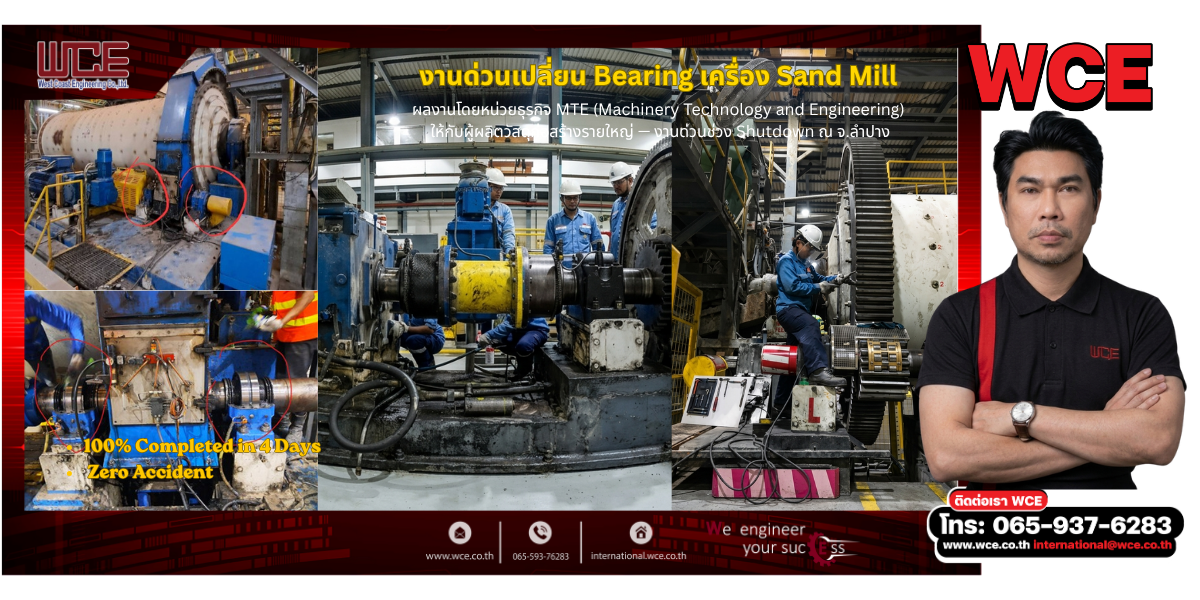
The sand mill is a critical piece of equipment in building materials manufacturing, used for grinding and blending raw materials such as sand, limestone, silica, and fiber-cement compounds. The bearings supporting the sand mill’s rotating shaft endure continuous heavy radial and axial loads, making them one of the most critical components for production line stability. When bearings reach the end of their service life, rapid and precise replacement during scheduled shutdowns requires highly specialized expertise. This article examines sand mill technology, bearing engineering fundamentals, replacement procedures, applicable standards, and a real-world project reference demonstrating WCE’s capabilities.
A sand mill (or ball mill in certain contexts) is a rotary grinding mill used to reduce raw materials—such as sand, limestone, silica, and cement fiber—to specified particle sizes. The operating principle involves a cylindrical drum rotating about its horizontal axis. The drum is charged with grinding media (steel balls, ceramic balls, or pebbles). As the drum rotates, the media is lifted by centrifugal force and then cascades down, impacting the raw material to achieve grinding and blending simultaneously [1].
A sand mill comprises several principal mechanical components: the shell/drum, a heavy-walled steel cylinder that rotates about its axis; the trunnion, hollow shafts at each end of the drum that support the entire weight of the drum and its contents; the bearings, which support the trunnions and absorb both radial and axial loads; the gear/pinion drive, where a small pinion gear driven by the motor meshes with a ring gear mounted on the drum; and the liner, internal wear plates that protect the drum shell from abrasion [2].
Sand mills employ large-bore bearings designed for heavy loads and relatively low rotational speeds. Common types include:
Bearings in sand mills degrade through several mechanisms:
Bearing replacement on a sand mill is a highly specialized operation requiring systematic execution:
Shutdown maintenance represents a critical window for performing preventive and corrective maintenance on components that cannot be serviced during normal operations. The primary challenge of shutdown work is the strict time constraint—every hour of production downtime represents significant cost. Efficient time and resource management is therefore the key success factor for shutdown maintenance execution [10].
| Item | Details |
|---|---|
| Project Name | Sand Mill Bearing Replacement |
| Client | A major building materials manufacturer in Thailand |
| Business Unit | MTE — Machinery Technology and Engineering |
| Scope | Cover removal, pinion cleaning and inspection, damage assessment, alignment check, bearing removal from shaft, crack inspection, new bearing assembly and installation |
| Site Location | Lampang Province, Thailand |
| Project Duration | 9–12 June 2026 (4 days) |
| Project Type | Emergency shutdown maintenance |
| Status | 100% Completed on schedule |
| Safety Record | Zero Accident |
1. Rapid Emergency Response This was an emergency shutdown project requiring immediate deployment for sand mill bearing replacement within a tight timeframe. The WCE team mobilized to Lampang Province promptly, arriving with a complete set of specialized tools and equipment ready for immediate execution.
2. Comprehensive End-to-End Service The team executed the full scope of work: cover removal and pinion cleaning, thorough inspection of all components, bearing removal and crack inspection, alignment verification, new bearing installation, and pre-handover testing—all performed as a single integrated service.
3. Completed Within 4-Day Shutdown Window The project was completed within the scheduled 4-day shutdown window, ensuring the client’s restart timeline was maintained without delay.
[1] Wills, B.A. & Finch, J.A. (2016). Wills’ Mineral Processing Technology, 8th Edition. Butterworth-Heinemann, Elsevier.
[2] Lynch, A.J. & Rowland, C.A. (2005). The History of Grinding. Society for Mining, Metallurgy, and Exploration (SME).
[3] ISO. (2021). ISO 15552 — Rolling Bearings. International Organization for Standardization.
[4] Harris, T.A. & Kotzalas, M.N. (2007). Rolling Bearing Analysis, 5th Edition. CRC Press, Taylor & Francis Group.
[5] SKF Group. (2018). SKF Rolling Bearings Catalogue. PUB BU/P1 10000/2 EN.
[6] ISO. (2007). ISO 281 — Rolling Bearings — Dynamic Load Ratings and Rating Life. International Organization for Standardization.
[7] ISO. (2003). ISO 1940-1 — Mechanical Vibration — Balance Quality Requirements for Rotors in a Constant (Rigid) State. International Organization for Standardization.
[8] ISO. (2009). ISO 10816-3 — Mechanical Vibration — Evaluation of Machine Vibration by Measurements on Non-Rotating Parts — Part 3: Industrial Machines. International Organization for Standardization.
[9] SKF Group. (2014). SKF Bearing Maintenance Handbook. SKF Group.
[10] Levitt, J. (2011). Complete Guide to Preventive and Predictive Maintenance, 2nd Edition. Industrial Press, Inc.
WCE delivers specialized bearing replacement and repair, shutdown maintenance, and comprehensive machinery engineering services across all industry sectors. Our experienced engineering teams and technicians are ready to mobilize nationwide at short notice.
📞 Tel: +66 65-937-6283 📧 Email: international@wce.co.th 🌐 Website: www.wce.co.th
We engineer your success.

